How Malta’s resident non-dom framework, Individual Tax Programme and business structures can support internationally active founders.
What’s Inside
Malta’s 2027 Individual Tax Programme can provide qualifying international entrepreneurs with a 15% tax rate on foreign income received in Malta. Its suitability, however, depends on considerably more than the headline rate. An entrepreneur must consider Malta’s underlying resident non-dom tax system, the source and character of personal income, the location from which international companies are managed, and the appropriate separation of operating businesses from accumulated family wealth. This publication explains how these elements interact and when Malta may offer an effective European base for an entrepreneur, business family or founder preparing for relocation, international expansion, succession or a future liquidity event.
Key Legal Points
- Malta’s resident non-dom framework determines the underlying tax base; the Individual Tax Programme adds an elective special rate.
- Qualifying foreign income received in Malta is taxed at 15%, subject to a €35,000 minimum annual tax for global and EU/EEA/Swiss resident status.
- Maltese-source income and other income outside the special rate are generally taxed at 35% under the programme.
- Foreign capital gains generally remain outside Maltese taxation for a resident non-dom, even when the proceeds are received in Malta.
- Managing a foreign company from Malta may affect its tax residence, permanent-establishment exposure and reporting obligations.
- A Maltese operating or holding company requires commercial purpose, governance and substance; it is not an automatic consequence of personal relocation.
- Immigration residence, work authorisation, personal tax residence, domicile and corporate residence remain separate legal questions.
- The entrepreneur’s operating business and accumulated family wealth may require different ownership and governance structures.
Who Is This For?
This publication is intended for founders, owner-managed business principals, technology entrepreneurs, investors, consultants, family-business owners and internationally mobile executives considering Malta as a personal residence and European business base. It is also relevant to family offices and professional advisers coordinating a founder’s residence, business interests, investments and succession arrangements across several jurisdictions.
What This Means for You
Malta should be assessed as an integrated residence, business and private-wealth jurisdiction rather than simply as a 15% tax programme. The appropriate outcome depends on the entrepreneur’s expected income and remittances, where the business is genuinely managed, whether Malta will become the family’s principal home, and how operating assets should be separated from long-term family capital. The planning should generally take place before relocation, before management functions move to Malta and, where possible, before a business disposal or other liquidity event.
Malta’s Resident Non-Dom Foundation
The starting point is Malta’s resident non-domiciled, or resident non-dom, tax framework. Residence and domicile are separate concepts under Maltese tax law. An individual can become resident in Malta without acquiring a Maltese domicile.
According to the Malta Tax and Customs Administration’s guidance on the remittance basis, an individual who is resident but not domiciled or not ordinarily resident in Malta is generally taxed on:
- income and capital gains arising in Malta;
- foreign income, but only to the extent that it is received in Malta; and
- no Maltese tax on foreign capital gains, even where those gains are subsequently received in Malta.
👉 Source: MTCA Remittance Basis Guidance
The distinction between income and capital is therefore fundamental. Dividends, interest, pensions, rental income and business income may constitute income. An inheritance, repayment of capital or proceeds from the disposal of a capital asset may be capital, although the classification depends on the facts and applicable law.
Remittances used for ordinary living expenses are generally presumed to represent income unless the taxpayer can substantiate a capital source. Entrepreneurs therefore need clear banking records and properly segregated income, capital and sale-proceeds accounts before relocating.
Under the ordinary resident non-dom rules, Maltese-source income and foreign income received in Malta are normally subject to Malta’s progressive individual rates. A separate minimum tax of €5,000 may apply to certain non-domiciled individuals whose foreign income reaches the statutory threshold. The 15% rate is not the resident non-dom system itself. It arises through a qualifying special tax status, including the new Individual Tax Programme.
“Malta’s international competitiveness does not rest on a single preferential rate. Its more important distinction is the tax base: Maltese-source income remains taxable, foreign income is taxed when received in Malta, and foreign capital gains generally remain outside the Maltese charge. The Individual Tax Programme should be understood as an elective layer built on that foundation.”
Dr Jean-Philippe Chetcuti
Senior Partner – Citizenship, Residency and Private Client Tax
Chetcuti Cauchi Advocates
How the 2027 Programme Works
The Individual Tax Programme Rules, 2026, come into force on 1 January 2027. The Rules consolidate four categories of special tax status:
- global resident status for qualifying third-country nationals;
- EU, EEA and Swiss resident status;
- retired pensioner status; and
- UN pensioner status.
👉 Full legal framework: www.ccmalta.com/publications/malta-15-tax-status-for-international-residents
International entrepreneurs will ordinarily consider either global resident status or EU/EEA/Swiss resident status, depending on their nationality.
For these two categories, foreign income received in Malta is subject to tax at 15%, with the possibility of claiming applicable double-taxation relief. A minimum annual tax of €35,000 applies. The minimum is payable in full in the year in which status is granted and in the year in which it ceases, meaning that it is not automatically apportioned according to the number of months for which the status is held. Income not qualifying for the 15% rate is generally taxed separately at 35% under the Rules.
The programme also requires:
- a non-refundable application fee of €8,500;
- a qualifying property purchased for at least €700,000 or rented for at least €14,000 annually;
- stable and regular resources;
- comprehensive sickness insurance covering the beneficiary and dependants;
- adequate communication in one of Malta’s official languages;
- satisfaction of the fit-and-proper requirement;
- continued representation by an authorised registered mandatary; and
- non-domicile in Malta, without an intention to establish a Maltese domicile during the relevant five-year period.
The qualifying Maltese property must be occupied as the beneficiary’s primary residence. The Rules define this as the dwelling in which the individual habitually resides as their “principal place of abode worldwide”. The property cannot be let or sublet while being used as the qualifying property.
The status is granted for five years and may be renewed for further five-year periods. Each renewal application carries a €2,500 administrative fee. Applications and ongoing filings must be handled through an authorised registered mandatary.
The programme does not, by itself, constitute an immigration or work permit. It grants a special tax status under the Income Tax Act. The entrepreneur must separately establish the legal basis for residing and, where relevant, working or carrying on a self-employed activity in Malta.
Status can cease where the beneficiary:
- becomes a Maltese national;
- becomes a long-term or permanent resident of Malta;
- loses or sublets the qualifying property;
- no longer holds the required medical insurance;
- spends more than 183 days in another jurisdiction during a calendar year;
- ceases to be represented by an authorised registered mandatary;
- fails to pay the minimum tax or submit the prescribed return; or
- otherwise ceases to satisfy the eligibility conditions.
The interaction with permanent residence requires particular attention. An entrepreneur whose longer-term objective is permanent or EU long-term residence may need to plan for the eventual cessation of ITP status and the resulting transition to a different Maltese tax basis.
When the ITP Suits Entrepreneurs
The programme is most relevant where the entrepreneur expects to receive substantial recurring foreign income in Malta.
At a 15% rate, the €35,000 minimum annual tax corresponds arithmetically to approximately €233,333 of qualifying foreign income received in Malta, before considering double-taxation relief and any other taxable income.
The ITP may be particularly suitable for an entrepreneur who:
- receives substantial foreign dividends or investment income;
- wants predictable taxation of recurring foreign income used in Malta;
- intends to establish a genuine principal residence in Malta;
- is relocating with a spouse and qualifying dependants;
- expects Malta to be a medium-term personal and commercial base;
- will maintain sufficient commercial substance outside Malta for businesses intended to remain foreign-resident; or
- is coordinating relocation with succession, investment or post-liquidity planning.
The programme may be less suitable where:
- annual foreign-income remittances are relatively modest;
- the entrepreneur’s principal income will arise from services physically performed in Malta;
- the individual intends to seek permanent or long-term residence shortly after arrival;
- Malta will not genuinely become the principal place of abode worldwide;
- the founder will continue to manage a foreign company informally from Malta;
- the departure jurisdiction continues to regard the individual or company as resident; or
- an unresolved exit tax, controlled foreign company rule or anti-avoidance provision applies elsewhere.
An entrepreneur expecting limited remittances should compare the ITP against the ordinary resident non-dom framework rather than assuming that the 15% rate produces the lower liability.
“The decisive question for an entrepreneur is not whether Malta offers a 15% rate. It is whether the expected foreign-income remittances justify the €35,000 minimum and whether that income remains foreign-source once the founder begins directing business activity from Malta.”
Magdalena Velkovska
Director – Private Client Tax
Chetcuti Cauchi Advocates
Managing International Business from Malta
An entrepreneur’s personal tax status does not determine the residence or taxation of their companies.
Once a founder begins conducting substantial business activity from Malta, several separate issues arise:
- where strategic and commercial decisions are taken;
- where board meetings and executive functions occur;
- where contracts are negotiated and concluded;
- where employees and operational teams work;
- where intellectual property is developed and managed;
- whether a foreign company has a Maltese permanent establishment;
- whether the foreign company’s management and control have moved to Malta; and
- whether the entrepreneur’s remuneration is foreign-source or Maltese-source.
👉 Related analysis: www.ccmalta.com/publications/guide-malta-companies-company-tax-system
The Malta Tax and Customs Administration states that a company may require Maltese income-tax registration where it is incorporated in Malta, where its management and control are located in Malta, or where it carries on an activity in Malta.
The ITP does not convert Maltese-source earnings into foreign income. Salary, consultancy income or business profits connected with activities performed in Malta may be taxable as Maltese-source income.
The entrepreneur should also review the law of the departure jurisdiction, which may continue to assert:
- individual tax residence;
- corporate residence;
- a permanent establishment;
- controlled foreign company taxation;
- exit taxation;
- transfer-pricing adjustments;
- social-security liability; or
- taxation of a subsequent business disposal.
Maltese Companies as a Business Base
A Maltese company can provide an established EU corporate platform for international business, but it should be used for a genuine commercial purpose.
👉 Learn more: https://www.ccmalta.com/solutions/malta-holding-company
A Malta company may function as:
- an international trading or operating company;
- an EU contracting company;
- a group headquarters or coordination company;
- an intellectual-property company;
- a holding company for international subsidiaries;
- a family investment company;
- an investment or co-investment platform; or
- a succession and governance vehicle.
Maltese companies are generally subject to corporate income tax at 35%. Malta operates a full imputation system and shareholder refund mechanisms depending on structure and income type.
👉 Corporate tax overview: www.ccmalta.com/publications/guide-malta-companies-company-tax-system
It is therefore inaccurate to describe Malta as having a universal 5% corporate tax rate.
“A founder’s personal relocation does not automatically justify moving every company or asset to Malta. The operating business, investment holdings and family wealth should each be located and governed according to their commercial purpose, substance and succession objectives.”
Dr Priscilla Mifsud-Parker
Managing Partner, ACC Advisors
Senior Partner – Tax, Family Office and Immigration, Chetcuti Cauchi Advocates
Separating Business and Family Wealth
Entrepreneurs often begin by holding most of their wealth through the operating business. As the business matures, wealth may need to be separated into:
- operating risk;
- intellectual property;
- strategic shareholdings;
- surplus corporate cash;
- investments;
- real estate;
- family assets; and
- succession structures.
👉 Related publication: www.ccmalta.com/publications/malta-family-investment-companies
A Maltese holding company, family investment company, trust or foundation may be used depending on objectives, but each structure must be assessed independently for tax, legal and cross-border recognition.
Planning Before Relocation
A coordinated review should include:
- departure tax analysis;
- income and capital mapping;
- comparison of ITP vs non-dom taxation;
- corporate residence review;
- Malta company structuring;
- asset separation planning;
- immigration alignment;
- remittance structuring; and
- compliance preparation.
How Our Tax and Immigration Lawyers Help
ACC Advisors and Chetcuti Cauchi Advocates advise on:
- Malta residence and tax structuring;
- Individual Tax Programme applications;
- cross-border corporate structuring;
- family office and wealth structuring;
- trusts and foundations;
- relocation planning; and
- ongoing compliance.
👉 Contact us: https://www.maltaimmigration.eu/contact-us
About the Expert Contributors
Dr Jean-Philippe Chetcuti – Senior Partner, Chetcuti Cauchi Advocates
https://www.ccmalta.com/people/jean-philippe-chetcuti
Dr Priscilla Mifsud-Parker – Managing Partner, ACC Advisors
https://www.maltaimmigration.eu/key-people/dr-priscilla-mifsud-parker/
Magdalena Velkovska – Director, Private Client Tax
https://www.ccmalta.com/people/magdalena-velkovska
Official Sources
All legislative and regulatory references are available via Malta’s official legislation portal and the Malta Tax and Customs Administration.
https://legislation.mt/eli/ln/2026/195/eng
https://legislation.mt/eli/cap/123/eng
https://mtca.gov.mt/business-tax/corporate/corporate_tax
https://mtca.gov.mt/business-tax/corporate/Income_Tax
About the Authors
Dr Jean-Philippe Chetcuti is Senior Partner at Chetcuti Cauchi Advocates and a leading Maltese practitioner in international private-client tax, citizenship and residence planning, and cross-border wealth structuring. He advises entrepreneurs, family offices and high-net-worth individuals on the interaction between Maltese tax residence, remittance-based taxation, corporate structuring and succession planning across multiple jurisdictions. His practice focuses on designing legally robust frameworks for internationally mobile clients whose affairs span business ownership, investment portfolios and family governance structures. He regularly works alongside foreign counsel to coordinate Malta’s tax and immigration regimes with the legal and tax systems of other countries.
Dr Priscilla Mifsud-Parker is Managing Partner of ACC Advisors and Senior Partner at Chetcuti Cauchi Advocates, specialising in international tax structuring, family office advisory, trusts and foundations, and complex cross-border relocation planning. She advises entrepreneurial families and corporate groups on aligning personal residence, business operations and long-term wealth preservation strategies. Her work includes the establishment of Malta-based holding structures, family investment companies and governance frameworks designed to support succession planning and intergenerational wealth transfer. She is widely recognised for her advisory role in multi-jurisdictional structuring projects involving both private and corporate clients.
Magdalena Velkovska is Director of Private Client Tax at Chetcuti Cauchi Advocates, advising on Maltese tax residence, non-domiciled taxation, special tax programmes and cross-border personal tax planning. She works closely with internationally mobile entrepreneurs and executives to structure income flows, remittances and investment holdings in a tax-efficient and compliant manner. Her practice includes detailed analysis of foreign income characterisation, treaty relief, and the interaction between Maltese tax rules and the tax regimes of other jurisdictions. She also supports clients in ensuring ongoing compliance with Maltese reporting obligations and special tax status requirements.
Together, the authors form part of an integrated private-client advisory team combining Maltese tax law, immigration law, corporate structuring and family wealth planning. Their work is focused on delivering coordinated solutions for entrepreneurs and families whose personal residence, business interests and investment structures span multiple countries and regulatory systems.

What Is the Malta Permanent Residence Programme?
The Malta Permanent Residence Programme (MPRP) is Malta’s residence by investment route for non-EU, non-EEA, and non-Swiss nationals. It grants successful applicants and their families the right to reside indefinitely in Malta, along with visa-free travel across the Schengen Area for 90 days out of every 180.
Often referred to as Malta residence by investment, the MPRP is administered by Residency Malta Agency and requires applicants to work through a licensed agent since applications cannot be submitted directly.
The programme was introduced under Legal Notice 121 of 2021, replacing the earlier Malta Residence and Visa Programme (MRVP), and has since been updated multiple times, most recently and significantly under Legal Notice 146 of 2025. That 2025 update introduced several important changes that materially affect how the programme works today:
- The introduction of a temporary residence permit: applicants can now obtain a one-year, renewable temporary residence permit shortly after submitting a redacted application and clearing initial background checks, letting them legally reside in Malta while the permanent residence application is still being processed
- Simplified contributions: a single flat government contribution now applies to the main applicant, replacing the previous two-tier system that charged a higher contribution for applicants on the lease route than the purchase route
- Greater flexibility on property rules: the regulations now allow more scope for renting out or subletting a qualifying property, where previously the rules were considerably more restrictive
Who Is the MPRP For?
The MPRP tends to suit a fairly specific set of profiles, more than a one-size-fits-all audience:
- Frequent travellers who want Schengen access: For Non-EU nationals who want to spend meaningful time in Europe, MPRP status gives them access to the Schengen Area for 90 in a 180-day period.
- Retirees: Malta’s climate, healthcare system, and English-speaking environment make it a popular base for retirees from outside the EU looking for a slower pace of life without giving up easy access to the rest of Europe.
- Those wanting to live in an English-speaking EU country: Malta is the only full EU member state where English is an official language, which removes a major barrier for applicants who don’t want to learn a new language to settle in Europe.
- Families wanting a multi-generational base: The programme’s four-generation dependant structure (spouse, children up to 28, parents, grandparents) suits applicants looking to relocate or provide security for an extended family, not just themselves.
- Those who don’t need or want to relocate immediately: Because there’s no minimum stay requirement, it also appeals to applicants who want the optionality of Maltese residence without committing to living there full-time.
Benefits of the MPRP
The Malta Permanent Residence Programme bestows a number of benefits to applicants and their family members including:
- Lifetime validity: The residence certificate itself does not expire, provided programme obligations are maintained, making it a genuinely permanent status rather than one requiring periodic requalification
- No minimum physical residence requirement: Unlike some EU residence routes, there’s no obligation to live in Malta for a set number of days each year
- Schengen mobility: Visa-free travel throughout the Schengen Area for up to 90 days in any 180-day period
- English-speaking environment: Day-to-day life, schooling, communication, road signs are all in English
- Family inclusion: A genuinely wide dependant framework spanning up to four generations and possibility to add another generation
- Political and economic stability: Malta is a long-standing EU and Eurozone member with a stable legal system and growing economy.
- Straightforward asset options: The qualifying investment can be met through a lease as well as a purchase, which lowers the up-front capital commitment compared to other residence options in Europe.
- Children’s residence rights are locked in for life: This is one of the MPRP’s biggest differentiators. Once a child is validly included as a dependant, they keep their Maltese permanent residence for life, even after they marry, turn 29, or are no longer financially dependent on the main applicant. What matters is the position at the time of application through to approval: at that point, the child must be under 29, unmarried, and financially dependent on the main applicant. Once approved, none of those conditions need to continue to be true for the child to keep their status.
Who Qualifies for the MPRP
To be eligible, applicants must:
- Be at least 18 years of age
- Be a third-country national (not a citizen of the EU, EEA, or Switzerland)
- Not be a national of, or have close ties to, a currently ineligible country. As of the latest programme guidelines, this list includes Afghanistan, North Korea, Iran, the Democratic Republic of Congo, Somalia, South Sudan, Sudan, Yemen, and Venezuela, along with the Russian Federation and the Republic of Belarus.
- Hold a clean criminal record and pass Malta’s four-tier due diligence process
Eligible dependants can include:
- Spouse, or partner in a long-term relationship equivalent to marriage (de facto partnerships are accepted with adequate supporting proof of the relationship)
- Children (including adopted) under 18
- Unmarried children up to 28 years of age, provided they are principally dependent on the main applicant.
- Parents and grandparents of the main applicant and/or their spouse
This “four-generation” structure is one of the more generous dependant frameworks among European residence-by-investment options. There is no upper age limit for parents or grandparents.
For any adult dependant the main applicant must provide a sworn affidavit confirming that the dependant is principally reliant on them, ideally supported by documentary evidence such as financial records or proof of shared residence. In practical terms, “principally dependent” means the dependant cannot maintain an independent, self-sufficient lifestyle without the main applicant’s support — an adult dependant with substantial personal wealth, significant income, or business interests of their own will generally not qualify, even if the main applicant continues to support them financially.
Retirement income does not automatically disqualify a parent or grandparent, provided genuine dependency can still be shown.
An additional government fee of €7,500 applies for each adult dependant included in the application, and household staff cannot be included as dependants under any circumstances.
Financial Requirements (Self-Sufficiency Test)
Applicants must demonstrate one of the following capital positions:
- €500,000 in capital, of which at least €150,000 must be in liquid financial assets, or
- €650,000 in capital, of which at least €75,000 must be in liquid financial assets
This capital requirement sits alongside and is separate from the property and government contribution obligations below. It applies only to the main applicant and does not scale up with the number of dependants included.
What counts as a financial asset: liquid holdings such as bank deposits, bonds, publicly listed or traded shares, and funds. Cryptocurrency is explicitly not accepted as a financial asset under the programme.
What counts toward the wider capital position: real estate can form part of the main applicant’s total capital, supported by an independent architect’s valuation. A jointly owned property is only counted toward the capital requirement to the extent of the spouse’s share, and only where the spouse is included in the application. Applicants who hold shares in a publicly listed company exceeding 10% of total shareholding must also submit supporting company documentation.
This capital position must be maintained and is monitored annually for the first five years via the official compliance declaration, signed by both the beneficiary and the licensed agent.
The MPRP Financial Requirements
Current requirements to qualify for the MPRP are:
- Administration fee: €60,000 total, payable in two stages:
- €15,000 on submission of the application
- €45,000 following issuance of the Letter of Approval in Principle
- Government contribution: €37,000
- Qualifying property, either:
- Purchase: minimum €375,000
- Lease: minimum €14,000 per year
- NGO donation: €2,000 to a local non-governmental organisation registered with the Commissioner for Voluntary Organisations, or another body approved by the Agency.
The €97,000 government fees cover the main applicant, spouse, and children under 18 who are principally dependent on the main applicant at the time of application. Every adult dependant beyond that carries an additional €7,500 government fee.
Applicants must also have a health insurance policy covering a minimum of €100,000 per year, for health expenses in Malta and other European countries.
Buying or Renting Property in Malta under the Malta Permanent Residence Programme
Property is one of the areas which is important as applicants need to rent or buy a property once they receive a letter of approval in principle, so it’s worth covering in depth.
Timing: Applicants do not need to already own or lease a qualifying property at the point of application. The property must be secured and the relevant documentation submitted within 8 months of the date the Letter of Approval in Principle is issued. Applicants would only need to have a property before approval, if opting to apply for the 1 year temporary residence permit.
Purchase route: The minimum value if purchasing a property should be of €375,000. Where a property was bought before the application date and improved at the applicant’s own expense, an independent architect’s valuation report can be used to demonstrate the property now meets the €375,000 threshold. A hotel room or similar unit does not qualify as the property must be residential.
Lease route: The minimum value if renting a property should be of €14,000 per year. The rental must also be registered with the Housing Authority.
Compliance, Renewals, and Ongoing Obligations
In order to maintain one’s status under the MPRP, applicants must for the first five years submit an annual compliance form, confirming that they still own or rent a property, that they still have a health insurance policy and also still maintain the minimum wealth.
The Role of Residency Malta Agency
Residency Malta Agency is the Maltese government body responsible for administering the MPRP from end to end. It sets and enforces the programme’s eligibility criteria, reviews every application through a four-tier due diligence process, and holds final decision-making authority via its Board of Approvals. Beyond due diligence, the Agency issues the Letter of Approval in Principle, the residence certificate, and the Letter of Final Approval, oversees biometric data capture, and conducts ongoing compliance monitoring for at least the first five years of a beneficiary’s residence, including the right to carry out random property spot-checks. It also maintains and enforces the list of licensed agents authorised to submit applications.
The Role of a Licensed Agent
An MPRP application can only be submitted through an officially licensed and approved agent, appointed under a formal Power of Attorney, such as our firm – holding licence RES-ACCA.
In practice, a licensed agent’s role covers the full lifecycle of an application:
- Carrying out an initial eligibility assessment before taking on a case
- Preparing and assembling the full application pack and supporting documentation to the Agency’s required standard
- Conducting and evidencing Know-Your-Client (KYC) checks on the and family members
- Submitting the application through the Agency’s Agents’ Portal, and liaising with case officers throughout the review process
- Guiding the applicant through the property, government contribution, and NGO donation obligations once the Letter of Approval in Principle is issued
- Certifying key application forms, including verifying the applicant’s identity via the Agency’s approved digital verification software
- Managing the mandatory five-year compliance period on the applicant’s behalf, including annual compliance declarations and card renewals
ACC Immigration (ACC Advisors Ltd.), holding Residency Malta Agency Licence Number RES-ACCA, has represented hundreds of applicants under the MPRP.
Documents Required for an MPRP Application
While the exact checklist varies slightly depending on individual circumstances (marital status, number of dependants, source of funds), the core documentation an agent will typically need to prepare an application pack includes:
- Identity documents: Full passport, national ID card, and driving licence (where applicable) for the main applicant and each dependant
- Civil status documents: Birth certificates for all applicants and dependants, marriage certificate(s), and any divorce certificates, even where the individual has since remarried.
- Military records, where applicable
- Police conduct certificates: From the applicant’s country of origin and from any country where they have resided for more than 6 months in the last 10 years
- Bank statements: Typically the last 3 months for the account the administration fee and contribution will be paid from
- Evidence of source of wealth and funds: Supporting documentation for how the applicant’s capital was accumulated, which may include security or investment portfolios, property appraisals, company financial statements, or equivalent evidence from a reputable or official source
- Health insurance policy: The health insurance should cover each beneficiary for a minimum of €100,000 per annum, and must cover full health expenses in both Malta and other European countries
Malta Permanent Residence Application Process and Timeline
| Stage | What happens | Typical duration |
| 1. Engage a licensed agent (RES-ACCA) | Sign a Power of Attorney and commence document preparation. | |
| 2. Submit application pack | Full application, KYC evidence, and supporting documents submitted to Residency Malta Agency | |
| 3. Pay initial fee to Residency Malta AGENCY | €15,000 of the €60,000 administration fee | Due within 1 month of submission (or before the biometric appointment, if applying for a temporary permit) |
| 4. Due diligence review | Four-tier vetting of the main applicant and dependants, including international checks | 3-7 months |
| 6. Letter of Approval in Principle | Issued once due diligence process is completed. | Remaining €45,000 administration fee due within 2 months of issuance |
| 7. Secure qualifying property | Purchase (€375,000+) or lease (€14,000+/year), plus the €37,000 contribution and €2,000 NGO donation | Property must be finalised within 8 months of the Approval in Principle |
| 8. Residence certificate issued | Once all documentation is submitted and accepted | Within about 7 days of final documentation being confirmed complete |
| 9. Biometrics and card issuance | Main applicant and all dependants attend in person to give biometric data | Residence cards printed roughly 2 weeks after biometrics are captured |

When seeking guidance on the Malta Permanent Residence Programme, it is essential to work with an officially licensed and approved MPRP agent. The Residency Malta Agency operates a strict regulatory framework governing who may represent applicants, and choosing a licensed agent is a key step in ensuring a properly managed and compliant application process.
Licensed MPRP agents are required to meet defined professional standards, including legal qualifications, professional indemnity insurance, and ongoing continuing professional development. They are also subject to regular oversight, audits, and compliance checks by the Residency Malta Agency to ensure continued adherence to programme rules and procedures.
ACC Immigration holds Licence Number RES-ACCA, issued by the Residency Malta Agency, confirming our authorisation to act as an officially approved MPRP agent. This licence reflects our regulated status and our responsibility to operate within the framework established by the programme.
What This Means for Your Application
Working with a licensed MPRP agent ensures your application is handled within the official systems of the Residency Malta Agency from start to finish.
At ACC Immigration, we submit applications directly through the Agency’s portals, communicate with case officers through official channels, and track progress in real time. This allows for a more structured and efficient process, with clearer communication and timely responses to requests for additional information.
Because we operate within a regulated framework, we are also required to follow strict procedures when handling client files, documentation, and compliance requirements. This ensures your application is properly organised, complete, and aligned with current programme standards at every stage.
Our team consists of immigration law professionals with extensive experience in Maltese residency programmes. We maintain continuous professional development to ensure our advice reflects the latest regulatory updates, procedural changes, and eligibility requirements issued by the Agency.
Our Approach at ACC Immigration
Before accepting any case, we carry out a structured eligibility assessment to ensure alignment with programme requirements. From there, we manage the process end-to-end, focusing on accuracy, efficiency, and discretion throughout.
We maintain direct communication with the Residency Malta Agency and provide clients with updates based on verified, real-time information. This ensures clarity at each stage of the process and reduces uncertainty during application processing.
As a licensed firm, we are accountable to the regulatory authority overseeing the programme. This provides clients with a structured and transparent framework throughout their application journey.
Malta Permanent Residence Programme – Key Requirements
The Malta Permanent Residence Programme (MPRP) is designed for non-EU nationals seeking long-term residence rights in Malta. The programme is based on a clear set of financial and eligibility requirements that must all be satisfied as part of a single application.
Applicants are required to make a one-time contribution to the Government, which includes a €60,000 administration fee, with an additional €7,500 payable for each dependent adult child or dependent parent of the main applicant or spouse. A Government contribution of €37,000 is also payable within eight months of approval in principle.
In addition, applicants must either rent a property in Malta for a minimum annual rent of €14,000 or purchase a property for at least €375,000. A further €2,000 donation must be made to a registered philanthropic, cultural, sport, scientific, animal welfare, or artistic NGO in Malta.
Applicants must also declare and evidence sufficient financial resources. This generally takes the form of either net assets of at least €500,000, including a minimum of €150,000 in financial assets, or net assets of at least €650,000, including a minimum of €75,000 in financial assets.
At the time of submission, an initial payment of €15,000 is required, which is credited against the overall Government contribution.
Key Benefits of the MPRP
The Malta Permanent Residence Programme offers a range of long-term benefits for applicants and their families.
Successful applicants are granted permanent residence status, which is valid for life and extends to eligible family members included in the application. The entire family can be included under a single application, providing a unified route to residency in Malta.
Family eligibility is broad, allowing for the inclusion of unmarried and financially dependent children up to the age of 28, as well as dependent parents and grandparents. Children who obtain residency under the programme retain their status even if they later marry or become financially independent, and may also extend residency rights to their own future spouses and children.
There is no minimum physical presence requirement in Malta, and no language test is required. Permanent residence status is granted upon approval in principle, with investment and property commitments structured around the approval process rather than upfront submission.
Property acquired under the programme may also be rented out, offering additional flexibility for investors.
Successful applicants benefit from visa-free travel across the Schengen Area and may also apply for a temporary residence permit during the process.
Our Malta Permanent Residence Services
ACC Immigration is a licensed Maltese immigration firm holding Licence Number RES-ACCA, issued by the Residency Malta Agency. For over 20 years, our team has assisted hundreds of high-net-worth individuals and families in securing Maltese permanent residence through the Malta Permanent Residence Programme.
We provide full support across all stages of the application process, including eligibility assessments, documentation preparation, submission to the Residency Malta Agency, and compliance throughout the mandatory five year compliance period.
In addition to application management, we advise clients on the legal, tax, and practical aspects of relocating to Malta. This includes guidance on accommodation, healthcare, insurance, education, and broader relocation planning to ensure a smooth transition for applicants and their families.
Our role is to provide clear, regulated, and practical support throughout the entire journey, ensuring that clients are fully informed and properly guided from initial assessment through to long-term residence in Malta.

The Malta Permanent Residence Programme (MPRP) is one of Europe’s leading residence by investment programmes, offering permanent residence rights in Malta and visa-free travel throughout the Schengen Area. One of the most common questions prospective applicants ask is: how much does the Malta Permanent Residence Programme cost?
In this guide, we provide a complete breakdown of MPRP costs, including administration fees, government contributions, property requirements, health insurance obligations, residence card fees, and additional expenses that applicants should consider before applying.
What is the Cost of the Malta Permanent Residence Programme?
The total cost of an MPRP application varies depending on your family size and whether you’re applying with dependants. In short the costs are €99,000 + property investment. The main fees broken down are as follows:
Administration Fee: €60,000 total
The Malta Permanent Residence Programme requires payment of a €60,000 administration fee.
The payment is divided into two stages:
- Initial non-refundable payment: €15,000 (due within one month of submission of the application)
- Remaining balance: €45,000 (due within two months of Letter of Approval in Principle)
Contribution Fee: €37,000 payable after approval
- Post-approval non refundable contribution of €37,000 covering the main applicant, spouse, and children under 18 who are principally dependent
- Each additional adult dependant: €7,500 extra
Mandatory NGO Donation: €2,000 payable after approval
Applicants are also required to make a €2,000 donation to a registered Maltese non-governmental organisation.
- Must be donated to a registered charitable, cultural, sports, scientific, animal welfare, or artistic organisation.
Health Insurance: €100,000+ minimum per annum
All beneficiaries included in the application must maintain comprehensive health insurance coverage.
The policy must:
- Cover medical treatment in Malta and in the EU
- Provide a minimum annual coverage of €100,000 per beneficiary
A valid health insurance must be maintained throughout participation in the programme.
Residence Card Processing Fees:
- Initial issuance: €500 per person (5-year validity)
- Address changes or lost cards: €50 per card
- Temporary residence card (1-year option): €100 per card
Costs Beyond Government Fees
While the fees above are mandatory governmental fees, several other expenses are essential to budget for:
Property Acquisition or Property Rental: The additional cost is securing a qualifying property. You must own or lease a residential property in Malta within 8 months of receiving your Letter of Approval in Principle.
- Purchase: Minimum €375,000 in a Special Designated Area
- Lease: Minimum €14,000 per annum
The qualifying property must be retained for at least five years following approval under the programme. If the property is bought, this can also be rented out, generating rental income for the applicant.
A Realistic Cost Scenario
Let’s walk through what a typical family application costs:
Family of four: Main applicant, spouse, and two children (both under 18)
| Fee | Cost |
| Administration fee (€60,000) | €60,000 |
| Contribution fee (€37,000) | €37,000 |
| NGO donation | €2,000 |
| Residence card fees (4 cards × €500) | €2,000 |
| Property rental (first year, €14,000/year) | €14,000 |
| Total First-Year Investment | €115,000 exc Health Insurance and Professional Fees |
Payment Methods and Timeline
The Residency Malta Agency accepts bank transfers only. All funds must come directly from the bank account declared in your application. If you’re using a company bank account (because you own the company), you’ll need to provide board authorization and company documentation.
Timeline for Payments:
- €15,000 initial fee: Due within 1 month of application submission
- €45,000 remaining administration fee: Due within 2 months of Letter of Approval in Principle
- €37,000 contribution fee: Due after Letter of Approval, before receiving residence certificate
- €2,000 NGO donation: Due after Letter of Approval, before receiving residence certificate
- Remaining costs (property, health insurance): Must be in place before residence certificate issuance
Is the MPRP Worth the Cost?
The Malta Permanent Residence Programme is widely regarded as one of the most attractive residence by investment programmes in Europe.
Key benefits include:
- Permanent residence rights in Malta
- Visa-free travel throughout the Schengen Area
- Inclusion of multiple generations of family members
- Access to a stable European Union jurisdiction
- Residence in an English-speaking country
- No minimum physical stay requirement to maintain residence status
For investors seeking long-term European residence rather than immediate citizenship, the MPRP compares favourably with other residence programmes available across Europe.
Frequently Asked Questions About MPRP Costs
-
How much does the Malta Permanent Residence Programme cost?The Malta Permanent Residence Programme involves a government contribution, a €2,000 NGO donation, residence card fees, and qualifying property and health insurance requirements.
-
Can I buy property instead of renting under the MPRP?Yes. Applicants may satisfy the property requirement by purchasing qualifying residential property with a minimum value of €375,000 instead of renting property for at least €14,000 per year.
-
Is the €37,000 contribution refundable?No. The government contribution payable under the Malta Permanent Residence Programme is non-refundable. However, upon submission of the application, the applicant only pays a €15,000 non-refundable fee.
-
Can parents and grandparents be included in an MPRP application?Yes. Subject to eligibility requirements, parents and grandparents may be included as dependants upon payment of the applicable additional contribution, provided they are financially dependent on the main applicant.
-
How long does the MPRP application process take?Processing times vary depending on the complexity of the application and due diligence procedures, but most applications are completed within six to nine months.
Our Malta Permanent Residence Services
ACC is a licensed Maltese immigration firm (Licence No. AKM-ACCA) specialising in the Malta Permanent Residence Programme (MPRP). For over 20 years, our team has assisted hundreds of high-net-worth individuals and families seeking to secure permanent residence in Malta through investment.
Our Malta Permanent Residence Programme specialists provide comprehensive guidance throughout the entire application process, from initial eligibility assessments and due diligence preparation to property selection and submission of the residence application. We advise clients on the legal, tax, and practical aspects of relocating to Malta, ensuring a smooth transition for applicants and their families.
In addition to managing the MPRP application process, we offer tailored relocation support, including assistance with accommodation, healthcare, insurance, education, and settling into life in Malta. Our experienced team will guide you through the programme requirements, expected timelines, and ongoing obligations, providing clear and professional advice at every stage of your journey to obtaining Maltese permanent residence.

Son yıllarda Avrupa’da alternatif yaşam planı oluşturmak isteyen yatırımcıların ilgisini en fazla çeken ülkelerden biri Malta olmaya devam ediyor. Akdeniz’in merkezindeki stratejik konumu, İngilizce konuşulan bir Avrupa Birliği ülkesi olması, güçlü finansal altyapısı ve yüksek yaşam standartları sayesinde Malta yalnızca bir yatırım destinasyonu değil, aynı zamanda uzun vadeli yaşam planlaması için de önemli bir merkez haline gelmiş durumda.
Özellikle Türk vatandaşları açısından değerlendirildiğinde Malta, Avrupa’da güvenli bir yaşam kurmak, çocuklarına uluslararası eğitim imkanları sunmak ve Schengen bölgesine erişim avantajı elde etmek isteyen aileler için dikkat çekici bir seçenek sunmaktadır.
Malta Permanent Residence Programme (MPRP) kapsamında yapılan başvurular sonucunda uygun yatırımcılar ve aile bireyleri Malta’da süresiz oturum hakkı elde edebilmektedir. Kamuoyunda çoğunlukla “Malta Golden Visa” olarak anılan bu program, Avrupa’daki diğer yatırım temelli oturum modellerine kıyasla daha esnek yapısıyla öne çıkmaktadır.
Malta Daimi Oturum Programı Nedir?
Malta Daimi Oturum Programı, yatırım ve finansal yeterlilik kriterlerini karşılayan üçüncü ülke vatandaşlarına Malta’da kalıcı oturum hakkı sağlayan resmi bir programdır. Program ilk olarak 2021 yılında yürürlüğe girmiş ve kısa süre içerisinde Avrupa’daki en çok talep gören oturum programlarından biri haline gelmiştir.
Program kapsamında elde edilen statü süresizdir. Oturum kartlarının belirli aralıklarla yenilenmesi gerekse de kazanılan oturumun statüsü ömür boyu devam etmektedir.
MPRP’nin en önemli özelliklerinden biri ise Malta’da yılın belirli bir bölümünde yaşama zorunluluğu bulunmamasıdır. Bu durum özellikle iş hayatı farklı ülkelerde devam eden yatırımcılar açısından önemli bir esneklik sağlamaktadır.
Program aynı zamanda başvuru sahiplerine Schengen bölgesinde serbest dolaşım avantajı da sunmaktadır.
Malta Neden Bu Kadar Tercih Ediliyor?
Avrupa’da yatırım yoluyla oturum programları değerlendirilirken yatırımcıların en fazla önem verdiği kriterler arasında siyasi istikrar, yaşam kalitesi, eğitim imkanları, hukuki güvence ve uzun vadeli sürdürülebilirlik yer almaktadır. Malta ise bu alanların büyük bölümünde güçlü bir profil çizmektedir.
Ülkenin Avrupa Birliği üyesi olması, İngilizcenin resmi dil olarak kullanılması ve uluslararası yatırımcılara yönelik gelişmiş bankacılık sistemi Malta’yı özellikle global yaşam planlaması yapan aileler için avantajlı hale getirmektedir.
Bunun yanında Malta’nın düşük suç oranı, Akdeniz iklimi ve uluslararası topluluğa sahip yapısı da yaşam kalitesi açısından dikkat çekmektedir.
Programın en önemli avantajlarından biri de aile odaklı yapısıdır. Başvuru sahibi yalnızca eşini ve küçük çocuklarını değil, belirli şartlar altında yetişkin çocuklarını, ebeveynlerini ve büyükanne-büyükbabalarını da aynı dosya kapsamında programa dahil edebilmektedir.
Bu yönüyle Malta programı, yalnızca bireysel yatırımcılar için değil, aile bazlı uzun vadeli yerleşim planı yapan kişiler açısından da güçlü bir alternatif oluşturmaktadır.
Malta Golden Visa Başvuru Şartları
Malta Daimi Oturum Programı kapsamında başvuru sahiplerinin yerine getirmesi gereken bazı yatırım ve mali yeterlilik kriterleri bulunmaktadır.
Programın en dikkat çekici taraflarından biri, yatırım yükümlülüklerinin önemli bölümünün devlet onayı sonrasında tamamlanabilmesidir. Bu durum yatırımcı açısından süreci daha kontrollü ve güvenli hale getirmektedir.
Devlet Başvuru Ücretleri
Program kapsamında toplam 60.000 EUR resmi işlem bedeli bulunmaktadır.
Bu tutarın 15.000 EUR’luk kısmı başvuru aşamasında ödenirken, kalan 45.000 EUR ise başvurunun olumlu sonuçlanmasının ardından 2 ay içerisinde tahsil edilmektedir.
Belirtilen ücret; ana başvuru sahibi, eş ve reşit olmayan çocukları kapsamaktadır.
Başvuruya yetişkin bağımlı çocuklar, ebeveynler veya büyükanne-büyükbabaların dahil edilmesi halinde her ek yetişkin aile bireyi için ayrıca resmi ücret uygulanmaktadır.
Devlet Katkı Payı
Başvurunun onaylanmasının ardından Malta Hükümeti’ne 37.000 EUR tutarında katkı payı ödenmesi gerekmektedir. Bu ödemenin yapılması için başvuruculara oturum hakkının kesinleşmesi sonrasında 8 aylık bir süre verilmektedir.
Gayrimenkul
Başvuru sahibinin Malta’da uygun nitelikte bir konuta sahip olması zorunludur. Program bu konuda iki farklı seçenek sunmaktadır.
Kiralama Opsiyonu: Başvuru sahipleri yıllık minimum 14.000 EUR kira bedeline sahip bir konut kiralayarak program şartını yerine getirebilir.
Satın Alma Opsiyonu: Alternatif olarak minimum 375.000 EUR değerinde bir gayrimenkul satın alınabilmektedir.
Satın alınan mülklerin belirli koşullar altında kısa dönemli kiralama amacıyla değerlendirilmesi mümkün olabilmektedir. Bu durum bazı yatırımcılar açısından ek gelir potansiyeli yaratabilmektedir.
Malta programının önemli avantajlarından biri, gayrimenkul yatırımının başvuru öncesinde zorunlu tutulmamasıdır. Başka bir ifadeyle yatırımcılar önce devlet onayını alıp daha sonra yatırım aşamasına geçebilmektedir.
Bu yaklaşım, özellikle süreç riskini minimize etmek isteyen yatırımcılar açısından önemli bir güven unsuru oluşturmaktadır.
Hayır Kurumu Bağışı
Program kapsamında başvuru sahibinin Malta’da kayıtlı bir sivil toplum kuruluşuna minimum 2.000 EUR bağış yapması gerekmektedir.
Söz konusu bağış yükümlülüğü de devlet onayı sonrasında yerine getirilmektedir.
Ekonomik Yeterlilik Şartı
Malta Hükümeti, başvuru sahiplerinin belirli bir mali güce sahip olduğunu göstermesini talep etmektedir.
Bu kapsamda ana başvuru sahibinin:
- Toplam net varlıklarının değerinin en az 500.000 EUR olması ve bunun da minimum 150.000 EUR’luk kısmının likit finansal varlıklardan oluşması gerekmektedir
veya
- Toplam net varlıklarının değerinin en az 650.000 EUR olması ve bunun da minimum 75.000 EUR’luk bölümünün finansal varlıklarda tutulması gerekmektedir.
Likit finansal varlıklar arasında banka mevduatları, yatırım fonları, hisse senetleri ve benzeri finansal enstrümanlar yer alabilmektedir.
Ayrıca başvuru sahiplerinin program kapsamındaki ilk 5 yıllık uyum süreci boyunca ilgili finansal yeterlilik şartlarını koruduklarını gösterebilmeleri gerekmektedir. Malta makamları bu süreç içerisinde ek belge ve güncel finansal evrak talep edebilmektedir.
Programa Hangi Aile Bireyleri Dahil Edilebilir?
Malta Golden Visa programı aile bazlı yapılandırılmıştır.
Başvuru sahibi aşağıdaki aile bireylerini aynı başvuru kapsamında programa dahil edebilmektedir:
- Eş veya partner
- 28 yaşını aşmamış, evli olmayan ve maddi olarak bağımlı çocuklar
- Anne ve baba*
- Büyükanne ve büyükbabalar*
*Yetişkin aile üyelerinin başvuruya eklenebilmesi için kişilerin ana başvurucuya finansal olarak bağımlı olmaları, üzerlerinde kendilerine ait malvarlıklarının bulunmaması gerekmektedir.
Bu yapı özellikle Avrupa’da çok kuşaklı yaşam planı oluşturmak isteyen aileler açısından önemli avantaj sağlamaktadır.
Eğitim ve Sağlık Sistemi
Program kapsamında tüm aile bireylerini kapsayan özel sağlık sigortası yaptırılması zorunludur. Sigorta poliçesinin Malta ve Avrupa Birliği ülkelerinde geçerli olması ve kişi başı minimum 100.000 EUR teminat sağlaması beklenmektedir.
Ayrıca, başvuru sahiplerinin program kapsamındaki ilk 5 yıllık uyum süreci boyunca geçerli sağlık sigortasını korumaya devam etmeleri gerekmektedir. Yetkili makamlar bu süre içerisinde program şartlarının sürdürüldüğünü gösteren ek belge ve güncellemeler talep edebilmektedir.
Malta’da yaşayan aileler açısından ülkenin İngilizce eğitim sistemi de önemli avantajlardan biridir. Özellikle uluslararası okullar ve İngilizce eğitim altyapısı, çocuklu ailelerin Malta’yı tercih etmesindeki temel sebepler arasında yer almaktadır.
Gayrimenkulün Elde Tutulma Süresi
Program kapsamında kiralanan veya satın alınan gayrimenkulün en az 5 yıl boyunca muhafaza edilmesi gerekmektedir. Aynı şekilde, ilk 5 yıllık uyum süreci boyunca başvuru sahiplerinin program şartlarını koruduklarını göstermeleri beklenmektedir.
Beş yıllık sürenin tamamlanmasının ardından başvuru sahiplerinin Malta’da gayrimenkul bulundurma zorunluluğu devam etmemektedir. Bununla birlikte, oturum kartlarının yenilenebilmesi için Malta’da uygun bir adres gösterilmesi gerekir.
Bu durum, Malta daimi oturum statüsünün kaybedildiği anlamına gelmez. Başvuru sahipleri diledikleri zaman Malta’da uygun bir adres sunarak oturum kartlarını yeniden yenileyebilmektedir.
Başvuru Süreci Malta’ya Gitmeden Yürütülebilir mi?
Evet. Başvuru sahiplerinin süreç başlangıcında Malta’da bulunması zorunlu değildir.
Başvurular yalnızca lisanslı temsilciler aracılığıyla yapılabilmektedir. Sürecin ilerleyen aşamalarında aile bireylerinin biyometrik işlemler için Malta’ya kısa süreli seyahat etmesi gerekmektedir.
Sonuç
Malta Daimi Oturum Programı, Avrupa’da uzun vadeli oturum hakkı elde etmek isteyen yatırımcılar için günümüzde en dikkat çekici seçeneklerden biri olarak değerlendirilmektedir.
Programın esnek yapısı, aile bireylerini kapsaması, fiziksel ikamet zorunluluğu içermemesi ve İngilizce konuşulan bir Avrupa Birliği ülkesinde yaşam imkanı sunması Malta’yı özellikle Türk yatırımcılar açısından güçlü bir alternatif haline getirmektedir.
Avrupa’da ikinci bir yaşam planı oluşturmak, çocuklarına uluslararası fırsatlar sunmak ve uzun vadeli mobilite avantajı elde etmek isteyen aileler için Malta Golden Visa programı stratejik bir çözüm sunmaktadır.
Program hakkında detaylı bilgi almak veya ailenizin uygunluk durumunu değerlendirmek isterseniz alanında uzman Türk avukatlarımız ile iletişime geçerek ücretsiz danışmanlık görüşmesi talep edebilirsiniz.
In recent weeks, escalating geopolitical tensions and armed conflict across the Middle East have heightened concerns among many international families about long-term stability and security. The ongoing confrontation together with rising tensions affecting several Gulf countries, has underscored how quickly regional dynamics can shift. Missile and drone attacks have already reached parts of the Gulf, raising concerns about the safety of critical infrastructure, trade routes, and what matters most – the safety of our families.
Against this backdrop, many globally mobile individuals and families are increasingly considering the importance of securing a stable and secure base in Europe. For those living in regions exposed to geopolitical risk, having the ability to relocate quickly to a safe and politically stable jurisdiction has become an important element of long-term planning and family security.
Malta has emerged as a particularly attractive destination in this context. As a member of the European Union and the Schengen Area, Malta offers political stability, a strong rule of law, and a secure environment for families and businesses. The country also maintains a long-standing policy of constitutional neutrality, meaning it does not host foreign military bases or participate in military alliances, further reinforcing its reputation as a peaceful and stable jurisdiction.
Another major advantage is that English is an official language, making relocation and integration significantly easier for international residents.
Temporary Residence Permit
Through the Malta Permanent Residence Programme (MPRP), Non-EU nationals can obtain permanent residency in Malta through a structured investment framework. Importantly, the programme also allows applicants to obtain a temporary residence permit early in the process within just 30 days, enabling families to establish legal residence in Malta while their permanent residence application is being processed.
Once the temporary residence permit is issued, the complete permanent residence application must be submitted within six months.
Application Process for the fast-track residence permit
The procedure typically begins with the signing of a Power of Attorney, authorising us as a licensed agent to act on behalf of the main applicant and manage the application process with the authorities.
To apply for the temporary residence permit, the main applicant must pay an initial administrative fee of €15,000, which is later deducted from the overall administrative fee payable under the programme.
Each temporary residence card also carries a €100 issuance fee, payable during the biometric data capture appointment.
Following biometric submission and verification of the documentation, residence cards are typically issued within approximately four weeks, provided the application file is complete and accurate.
This process allows applicants to obtain legal residence status relatively quickly, offering peace of mind to families who wish to establish a European foothold while their permanent residence application is being processed.
Documents Required for the fast-track residency card
Applicants must submit a comprehensive application pack to the authorities. While the exact documentation may vary depending on the applicant’s circumstances, the core documents typically include the following:
- Covering Letter outlining the applicant’s background and eligibility for the programme
- Power of Attorney, authorising us as the licensed agent to represent the applicant throughout the application process
- Passport copies for the main applicant and all dependants included in the application
- Valid health insurance policy
- Proof of residential address, typically through a qualifying lease agreement or property purchase agreement in Malta
- Due diligence documentation carried out by us as the licensed agent to verify the applicant’s background and compliance with regulatory requirements
- Bank statements for the previous three months demonstrating financial standing
- Official government application forms required under the programme, completed and signed by the applicant and dependants where applicable
We take care of reviewing and compiling the application file, ensuring that all documentation meets the standards required by the relevant authorities before submission.
Requirements of the Malta Permanent Residence Programme
To qualify for permanent residence in Malta, applicants must satisfy three main requirements, together with certain financial eligibility criteria.
Government Contribution and Administrative Fees
Applicants must pay the following government fees:
- Government Administrative Fee – €60,000
An additional €7,500 government fee applies for each additional adult child and for parents of the main applicant or spouse included in the application.
- Government Contribution – €37,000, payable within eight months from approval in principle.
At the time of submission, an initial payment of €15,000 must be made, which is deducted from the administrative fee.
Qualifying Real Estate in Malta
Applicants must maintain qualifying residential property in Malta through one of the following options:
- Renting a property with a minimum annual rent of €14,000, or
- Purchasing a property with a minimum value of €375,000
The qualifying property must be maintained for at least five years.
Philanthropic Contribution
Applicants are also required to make a €2,000 donation to a Maltese registered organisation operating in fields such as philanthropy, culture, sports, science, animal welfare, or the arts.
Financial Eligibility
Applicants must demonstrate that they possess sufficient financial resources by declaring one of the following:
- Assets of at least €500,000, including €150,000 in financial assets, or
- Assets of at least €650,000, including €75,000 in financial assets
These requirements ensure applicants have the financial capacity to support themselves and their families.
Why Malta Is One of the Safest Countries in Europe
Malta is widely regarded as one of the safest jurisdictions in Europe, making it particularly attractive for families seeking stability and security.
Several factors contribute to this reputation.
- Firstly, Malta maintains a policy of constitutional neutrality, meaning the country does not participate in military alliances and does not host foreign military bases. This longstanding position reinforces Malta’s role as a peaceful and politically stable jurisdiction.
- Secondly, Malta benefits from strong institutions, a robust legal system, and very low levels of serious crime compared to many other countries.
- Finally, Malta’s small size and cohesive society contribute to a strong sense of community and safety that is highly valued by international residents.
These factors, combined with EU membership and a stable economy, make Malta a particularly appealing option for families seeking a safe European base in uncertain times.
Excellent International Connectivity
Another important advantage of living in Malta is its excellent international connectivity.
The island’s main airport, Malta International Airport, offers direct connections to numerous major European cities including London, Frankfurt, Paris, Rome, and Istanbul.
From Malta, most European capitals can be reached within two to three hours, making the island an ideal base for internationally mobile individuals, entrepreneurs, and families who travel frequently for business or leisure.
Key Benefits of the Malta Permanent Residence Programme
The Malta Permanent Residence Programme offers numerous advantages for international families seeking a stable European residence.
These include:
- Permanent residence status for life for the main applicant and eligible family members
- The possibility to obtain temporary residence early in the process in just 30 days
- One single application covering the entire family
- Inclusion of unmarried financially dependent children up to the age of 28
- Inclusion of financially dependent parents and grandparents
- Retention of residence rights even if dependants later marry or become employed
- Future spouses and children of dependants may also qualify
- Visa-free travel within the Schengen Area for short stays
- No minimum physical stay requirement in Malta
- No language or integration test
- Property acquired under the programme may be rented out
- Investment obligations arise only after approval in principle
A Strategic European Residence Option
For internationally mobile families seeking security, mobility, and long-term stability, the Malta Permanent Residence Programme represents one of the most attractive residency options currently available in Europe.
With the possibility of obtaining temporary residence at an early stage, a clear and transparent investment framework, and the advantages of living in a safe English-speaking EU country, Malta continues to position itself as a strategic European residence destination for individuals looking to safeguard their future in an increasingly unpredictable world. Get in touch with us to learn more about the programme.
Families applying for residency or citizenship in Malta frequently wish to extend the benefits of their status to close family members. Determining who qualifies as a dependant is therefore a key step in the application process and often one of the first questions raised by prospective applicants. However, the definition of a dependant is not uniform across Maltese immigration routes. Each programme sets its own eligibility criteria based on age, financial reliance, and family relationship, and these distinctions can significantly impact both eligibility and overall application strategy. Understanding these differences at the outset helps families plan effectively, avoid delays, and ensure that all qualifying relatives can be included from the beginning of the process.
A Comprehensive Guide to Dependant Eligibility
In Maltese immigration law, a dependant is generally defined as a family member who is materially reliant on the principal applicant. This reliance typically covers accommodation, daily living expenses, education, healthcare, and other essential needs.
As a general rule, individuals who are financially self-sufficient or economically independent will not qualify to be added to a residency or citizenship application. Married children are also excluded from dependant status, as they are presumed to form part of a separate household unit.
By contrast, the spouse of the principal applicant may be included within the same application regardless of employment status or personal income. The determining factor is the existence of the marital relationship rather than financial reliance.
For all other adult family members, substantial financial dependence must be demonstrated at the time of application, usually through evidence of ongoing support and shared household arrangements.
Malta Residency and Citizenship Routes: Qualifying Family Members
Malta Global Residence Programme (GRP) and The Residence Programme (TRP)
The Malta Global Residence Programme aimed at attracting Non-EU/EEA/Swiss nationals, and it’s equivalent for EU nationals, The Residence Programme (TRP) allows for the inclusion of family members, with slightly different age thresholds and conditions.
Eligible dependants include:
- The spouse of the main applicant in a legally recognised marriage or a partner with whom the beneficiary is in a stable and durable relationship.
- Minor children under 18 years of age.
- Unmarried adult children between 18 and 25 years of age, provided they are wholly or mainly financially dependent on the main applicant.
- Parents and grandparents of the main applicant or spouse who are principally maintained by the applicant.
- Siblings of the main applicant or spouse, where financial dependence can be demonstrated and where the main applicant is a legal guardian.
- In specific circumstances, household staff who have formed part of the applicant’s household for at least two years, prior to the submission of an application, and continue to be supported by the applicant. For Non-EU employees, work permit in Malta will be required.
In all cases, the competent authorities assess dependency on the basis of actual maintenance and financial reliance rather than solely on age or employment status.
Malta Permanent Residence Programme (MPRP)
The Malta Permanent Residence Programme (MPRP) grants permanent residence rights in Malta to non-EU/EEA/Swiss nationals and their families through a government-regulated investment and contribution framework. Successful applicants obtain lifelong residence status in Malta, visa-free travel across the Schengen Area (up to 90 days in any 180-day period), and the ability to settle in a stable EU jurisdiction with access to high standards of healthcare, education, and security.
A main applicant may include the following dependants, provided the applicable dependency conditions are satisfied:
- Spouse or partner in a long and durable relationship.
- Children up to 28 years of age, provided they are unmarried and fully financially dependent on the Main Applicant.
- Dependent parents or grandparents of both the main applicant or the spouse, provided they show full financial dependency on the main applicant.
- Adult children with certified disabilities regardless of age where they are financially dependent on the main applicant.
Malta Nomad Residence Permit
Malta’s Nomad Residence Permit is designed for remote workers, freelancers, and entrepreneurs employed or operating outside Malta who wish to live in the country while continuing their foreign-based professional activity. The permit allows third-country nationals to legally reside in Malta for an initial one-year period (renewable), enjoy visa-free travel across the Schengen Area for short stays, and experience life in an EU member state without becoming tax resident by default (subject to individual circumstances). The programme is particularly suited for location-independent professionals seeking a safe, English-speaking Mediterranean base.
The Main Applicant can include the following qualifying family members in an application. The eligible dependants are:
- The spouse of the applicant.
- Minor children of the applicant and/or of the spouse.
- Adult children of the applicant and/or spouse, who are not married and are principally dependent on the applicant.
In the case of a minor child for whom the applicant does not hold sole custody and who will not be accompanied by both parents in the same application, prior approval to include the dependant must be obtained from Residency Malta, as these requests are examined on a case-by-case basis.
Malta Retirement Programme
The Malta Retirement Programme (MRP) is a special tax residence scheme designed for non-Maltese nationals who receive a pension as their regular source of income and wish to relocate to Malta. The programme grants residence in Malta together with a favourable tax status, including a flat tax rate on foreign-source income remitted to Malta (subject to minimum annual tax). Beneficiaries must hold qualifying property in Malta and genuinely reside in the country, making the programme particularly attractive for retirees seeking an EU lifestyle, security, and access to high-quality healthcare in an English-speaking environment.
An applicant for the Malta Retirement Programme (MRP), can include certain close family members as dependants as follows:
- A legally married spouse or a long-term partner in a stable and durable relationship with the beneficiary.
- Minor children including adopted children.
- Adult children up to the age of 25 as long as they are not economically active.
- Brothers, sisters and direct relatives in the ascending line of the main applicant and the beneficiary’s spouse or partner. To be eligible, the main applicant must be a legal guardian of their siblings.
- Household staff who have been providing services to the beneficiary for at least two years prior to an application. For Non-EU employees, work permit in Malta will be required.
Maltese Citizenship by Merit
For Maltese Citizenship by Merit applications, family inclusion is more limited as outlined below:
- Spouse or recognised partner of the main applicant.
- Unmarried children up to the age of 28 years if they can show that they are financially dependent on the main applicant.
- Adult children (regardless of age) who have a recognised disability and are substantially supported by the main applicant.
Dependants Eligibility Summary
| Route | Spouse / Partner | Minor Children | Unmarried Adult Children | Parents | Other |
|---|---|---|---|---|---|
| Global Residence Programme (GRP) | Yes | Yes | Up to 25 years (and any age if with disability) | Yes | Siblings & Household Staff |
| The Residence Programme (TRP) | Yes | Yes | Up to 25 years (and any age if with disability) | Yes | Siblings & Household Staff |
| Malta Permanent Residence Programme (MPRP) | Yes | Yes | Up to 28 years (and any age if with disability) | Yes | N/A |
| Malta Nomad Residence Permit | Yes | Yes | Yes | No | N/A |
| Malta Retirement Programme | Yes | Yes | Up to 25 years | Yes | Siblings & Household Staff |
| Maltese Citizenship by Merit | Yes | Yes | Up to 28 years (and any age if with disability) | No | N/A |
Key Principles Across All Routes
Across Malta’s residence programmes, certain dependency principles consistently apply:
Spouses and minor children are generally recognised as eligible dependants.
Adult dependants must typically be unmarried and financially dependent on the main applicant, unless specific exceptions apply, such as a certified disability or medical condition.
Practical Considerations
As outlined above, each Maltese pathway adopts its own definitions, age thresholds, and evidentiary requirements for family inclusion. Some programmes permit adult children up to a specified age, others focus strictly on financial dependency, while certain routes extend eligibility to wider family members under particular conditions.
Given these distinctions and the documentary scrutiny involved, applicants should seek professional guidance to assess how the rules apply to their specific family structure and to ensure the correct supporting documentation is prepared from the outset.
For expert, confidential advice on the MPRP, citizenship by merit, or other Maltese residency options, contact us to discuss how Malta can enhance your future.

The firm acts as a Malta immigration agent for international lawyers, immigration firms and professional advisors in all their interests in Malta, providing Malta residence and citizenship due diligence, file-building, immigration submission, reviews and appeals for their clients.
Licensed Malta Residence Agents
Malta continues to stand out as a premier destination for high-net-worth individuals, families, entrepreneurs, and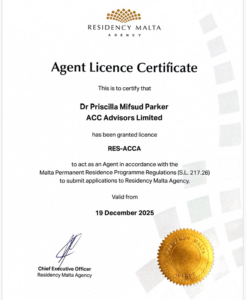 investors seeking residency benefits, a high quality of life, and strategic advantages in Europe. As a fully licensed Malta Residency Agent, ACC Immigration with Company registration number C-44042 provides expert, lawyer-led compliant guidance through the country’s key immigration pathways.
ACC Immigration holds the official licence RES-ACCA, as listed by the Residency Malta Agency, authorizing it to submit applications under the Malta Permanent Residence Programme (MPRP). This program, regulated under the latest amendments including Legal Notice 146 of 2025, enables non-EU/EEA/Swiss nationals to obtain indefinite permanent residence in Malta. Successful applicants enjoy visa-free travel across the Schengen Area, along with the right to live, work, and study in Malta. The process involves qualifying investments, such as property purchase or lease, a government contribution, and a charitable donation combined with comprehensive multi-tier due diligence to confirm applicants are fit and proper.
Furthermore, ACC Immigration is recognized as a Competent Professional authorized to submit applications for citizenship through merit. Under Malta’s Citizenship Act and related regulations this pathway grants Maltese citizenship to individuals who have rendered or commit to render exceptional services or contributions to the Republic of Malta or to humanity. This may encompass fields like entrepreneurship, philanthropy, science, culture, sports, strategic investments, or other areas of national interest.
Our Licensed Malta Residence Agent

Our managing partner Dr Priscilla Mifsud-Parker is a private client lawyer with key expertise in Maltese permanent residence, Maltese citizenship law and tax residency in Malta. Priscilla has several years of experience in immigration law, estate and succession law, trusts and estates and property law. Priscilla has represented numerous entrepreneurs, investors, pensioners and family offices in their relocation, residence and citizenship matters, together with ancillary personal tax advice and estate management services.
At the helm is Managing Partner Dr Priscilla Mifsud-Parker, a warranted private client lawyer with extensive experience in Maltese permanent residence, citizenship law, tax residency, trusts, estates, property transactions, and wealth structuring. She has successfully assisted numerous clients including entrepreneurs, investors, family offices, high-net-worth individuals, and pensioners with their relocation needs, while providing tailored advice on asset protection, business reorganization, and optimization via licensed Maltese structures such as investment funds.
Malta Residence Lawyers
The ACC Immigration team, comprising Maltese immigration lawyers and due diligence professionals, offers personalized, end-to-end service. This includes assessing program eligibility, preparing documentation, liaising with authorities, and ensuring full regulatory compliance. The firm also extends holistic ancillary services in tax planning, legal structuring, and estate management to support complete relocation projects.
For international professionals, ACC Immigration provides valuable B2B partnerships, serving as a dedicated Malta agent for lawyers, bankers, immigration firms, and advisors worldwide. We handles due diligence, file preparation, application submissions and reviews on behalf of their clients.
Services are delivered in multiple languages: English, French, Italian, Arabic, Mandarin, Turkish, Russian, and Maltese, catering to a diverse global clientele.
About Malta
Malta’s appeal remains strong in 2026: an English-speaking EU member state since 2004 (Eurozone since 2008), with a vibrant history dating back to 7000 BC, a cosmopolitan lifestyle featuring upscale dining, entertainment, and outdoor activities, exceptional healthcare (free for residents and EHIC holders; mandatory comprehensive insurance for Non-EU applicants), low crime rates, stunning beaches, and excellent global connectivity via multiple airlines. The real estate sector offers variety from budget-friendly apartments to luxurious sea-view villas in gated communities or scenic locales, making it easy to find an ideal base.
Choosing a reputable Malta Residency Agent like ACC Immigration ensures your application is managed professionally, transparently, and efficiently, maximizing the chances of a positive outcome while aligning with your personal, family, business, or investment goals.
For expert, confidential advice on the MPRP, citizenship by merit, or other Maltese residency options, contact us to discuss how Malta can enhance your future.
REQUEST A FREE CONSULTATION
Fill out the form below to receive a free and confidential initial consultation.
In today’s world of economic uncertainties and political instabilities, more high-net-worth individuals and families are turning to Malta’s Permanent Residence Programme (MPRP) and Citizenship by Merit for secure EU residency, Schengen mobility, and potential citizenship pathways. These programs offer family protection and long-term European access.
Yet, while demand continues to rise, so do rejection rates. Malta operates one of the most stringent due diligence frameworks in the global investment migration landscape. A significant proportion of refusals are not the result of ineligibility per se, but of avoidable mistakes, often caused by poor preparation, inadequate disclosure, or reliance on unlicensed or inexperienced intermediaries.
This article outlines the most common reasons why Malta residency and citizenship applications are rejected and explains how working with a licensed, lawyer-led agency reduces the risk of rejection.
Top Reasons Malta MPRP and Citizenship Applications Get Rejected
Malta’s four-tier due diligence extends beyond criminal records to include reputational risks, politically exposed person (PEP) status, sanctions exposure, business affiliations, litigation history, adverse media, health concerns, and any perceived threat to Malta’s national security, public policy, EU relations, or international standing. Authorities draw from global databases, open-source intelligence, and third-party specialized due diligence firms. Inconsistencies or lack of transparency often result in automatic or discretionary refusal.
Insufficient or Unverifiable Source of Funds & Wealth Documentation
This is one of the most common and complex rejection triggers. Malta demands a detailed, traceable audit trail proving legitimate wealth accumulation frequently over at least ten years, covering business profits, dividends, investment returns, inheritances/gifts, salaries/bonuses, and asset disposals.
Applicants must demonstrate, with clarity and consistency, how their wealth was accumulated. Acceptable sources include:
- Business ownership and retained profits
- Dividends and investment income
- Employment income and bonuses
- Sale of assets (real estate, shares, businesses)
- Inheritances or family gifts (with supporting evidence)
Pitfalls include fragmented or informal records, unclear trails from reinvested profits/complex structures, ambiguous family gifts/loans, or sources deemed “unclean.” Any ambiguity is viewed as a serious integrity risk, leading to denial.
Non-Disclosure, Misrepresentation, Material Omissions, or False Declarations
Malta applies a zero tolerance approach to non-disclosure. Applicants must fully disclose prior visa refusals (especially in visa-free-to-Malta countries), tax investigations, lawsuits, arrests (even without conviction), ongoing probes, previous program denials, assets, or other material facts.
Even unintentional omissions are treated as equivalent to deliberate misrepresentation—often grounds for sole refusal. Cross-checks on family or business-linked applications frequently uncover discrepancies, triggering rejection under explicit regulations.
Due Diligence & Background Check Failures
Applications may also fail due to:
- Adverse media exposure or articles
- High‑risk PEP profiles
- Sanctions or proximity to sanctioned individuals or entities
- Association with controversial industries or jurisdictions
- Ongoing investigations or unresolved legal matters
In certain cases, serious health conditions or factors deemed to pose a burden or risk to Malta or the EU may also be taken into account.
Importantly, rejection does not always require proof of wrongdoing—risk perception alone can be sufficient.
Poor Advisor Choice
Agents or brokers offering low fees and “guaranteed” outcomes often skip preliminary checks, mishandle disclosures, present superficial or generic source of wealth reports, rely on outdated rules, or lack depth for complex cases—resulting in preventable failures.
A rejection carries lasting impact:, since prior denials must be disclosed in other programs the applicant might apply for, increasing scrutiny and limiting options for you, family, or associates.
Why Choose ACC Immigration
While many intermediaries can compile forms and submit applications, Malta’s high‑scrutiny environment demands far more than administrative support.
As a licensed agent under Residency Malta Agency (Licence RES-ACCA), ACC Immigration is headed by experienced lawyers who provide specialist immigration and due diligence services. Our lawyer-led approach delivers:
- Comprehensive pre-application due diligence to identify and mitigate risks early.
- Robust, legally sound documentation, wealth narratives, and strategic disclosures.
- Expert navigation of compliance and regulatory requirements
- Honest and realistic eligibility assessment prior to onboarding
With global demand rising, Malta prioritizes quality, well-prepared applicants who align with program integrity. At ACC Immigration, expert lawyer guidance from the outset isn’t an add-on—it’s the essential safeguard for your family’s future through MPRP or Citizenship by Merit application. Get in touch with us.
ACC Immigration is delighted to announce that our Managing Partner, Dr Priscilla Mifsud Parker, has been named one of the Uglobal Top 25 Global Migration Attorneys 2025. This respected honour highlights her extensive expertise in Maltese tax residency, residence and citizenship solutions, and international wealth and corporate structuring. Priscilla is one of only two Maltese lawyers featured in this year’s global ranking.
Uglobal Top 25 Global Migration Attorneys
Each year, Uglobal Immigration Magazine recognises professionals who demonstrate leadership, cross‑border advisory excellence, and meaningful contributions to the investment migration sector. Priscilla’s inclusion reinforces her reputation as a leading authority in residence and citizenship planning and international private client advisory.
About Priscilla Mifsud Parker
As Managing Partner at ACC, Priscilla brings over twenty years of experience advising high‑net‑worth families, entrepreneurs, and multinational organisations. Her key areas of specialisation include:
- Wealth structuring and long‑term preservation
- Trusts, estate planning & international succession
- Corporate and business structuring
- International tax planning and optimisation
- Maltese Residence and citizenship solutions
- Cross‑border planning for global families and investors
Priscilla is known for designing, implementing, and managing sophisticated international structures, including reorganisations, high‑value asset optimisation, and regulated investment vehicles.
A recognised innovator, she also led the establishment of Malta’s first cryptocurrency exchange in 2013 — at a time when no regulatory framework existed, marking her as a pioneer in fintech structuring and compliance.
Contribution to the Investment Migration Industry
Priscilla advises international private clients on Maltese tax residency, permanent residence, citizenship pathways, and multi‑jurisdictional wealth strategies.
Her current roles include:
- Chairperson of STEP Malta
- Member of the STEP Malta Technical Sub‑Committee
- Featured specialist on Investment Migration Insider (IMI)
Her presence within STEP reflects her leadership in shaping standards for trusts, estates, and international wealth succession.
ACC’s Residence & Citizenship Advisory
ACC proudly supports global clients with:
- Tailored residence and citizenship solutions
- Compliant, secure wealth and corporate structuring
- Long‑term private client advisory
- Cross‑border tax, estate, and succession planning
Driven by integrity, due diligence, and personalised service, ACC remains a trusted partner for families and individuals seeking stable, strategic international mobility and wealth preservation.
Congratulations to Priscilla on this outstanding achievement. Her recognition within the Uglobal Top 25 Global Migration Attorneys 2025 reinforces her leadership, vision, and significant contribution to the global investment migration sector.