Malta, a sun-drenched Mediterranean island, stands out as one of the world’s most progressive and LGBTQ+ friendly nations, attracting individuals and families eager to relocate to a place that embraces diversity. For nearly a decade, Malta has held the top spot on ILGA-Europe’s Rainbow Index, a testament to its robust legal protections, vibrant community, and forward-thinking policies. Whether you’re seeking a new home through the Malta Permanent Residence Programme (MPRP) or aiming for full citizenship via the Citizenship by Exceptional Services through Direct Investment, Malta offers a secure, gay-friendly haven with a high quality of life.
Why Malta is a Sanctuary for All
Malta’s leadership in LGBTQ+ rights is rooted in a series of groundbreaking achievements. Same-sex sexual activity has been legal since 1973, but the nation’s modern journey toward equality accelerated with milestones like the 2014 legalization of civil unions and anti-discrimination protections in employment. In 2015, the Gender Identity, Gender Expression, and Sex Characteristics Act made it possible to update legal gender without medical intervention—a global benchmark for personal freedom. The 2016 ban on conversion therapy, a European first, followed by same-sex marriage in 2017, cemented Malta’s status as a pioneer. Today, it’s one of only five countries worldwide to enshrine LGBTQ+ equality at a constitutional level.
This legal framework is matched by a warm, evolving society. Malta Pride, held annually in September, transforms Valletta into a rainbow-hued celebration, drawing locals and expats alike with its colorful march and festivities.
Malta Permanent Residence Programme (MPRP): Your Key to a New Life
For non-EU nationals seeking a stable base in a nation that celebrates equality, the Malta Permanent Residence Programme (MPRP) offers a straightforward path to permanent residency. This program invites individuals and families—including same-sex couples—to settle in Malta indefinitely through a practical investment process, unlocking a lifestyle rich in opportunity and acceptance.
Key Requirements
- Property Investment: Rent a property for at least €14,000 annually or purchase one for €375,000 or more, held for five years.
- Government Contribution: Pay a one-time fee of €110,000 if renting or €80,000 if buying, plus €10,000 per additional family member.
- Charity Donation: Contribute €2,000 to a registered local charity.
Same-sex couples can apply jointly, submitting a marriage or civil union certificate or proof of a stable relationship, ensuring all families are equally welcomed. Once approved, residents gain access to Malta’s top-rated healthcare system—offering comprehensive services, including specialized care—along with visa-free travel within the Schengen Zone for up to 90 days in a 180-day period, and many more benefits. With no minimum stay requirement, the MPRP suits those craving flexibility while enjoying a safe, low-crime environment where diversity thrives.
Maltese Citizenship by Investment
For those dreaming of full EU citizenship, Malta’s Citizenship for Exceptional Services by Direct Investment Programme provides a prestigious route after a residency period of 12 or 36 months. Holding a Maltese passport—among the world’s most powerful—means visa-free travel to over 190 countries and the freedom to live, work, and study anywhere in the EU.
Key Requirements
- Investment Contribution: €600,000 for a 36-month residency track or €750,000 for a 12-month track, plus €50,000 per dependent.
- Property Commitment: Purchase a property for €700,000 or rent one for €16,000 annually, both held for five years.
- Philanthropic Donation: Donate €10,000 to a registered Maltese charity or NGO.
This program warmly embraces same-sex couples and families, reflecting Malta’s commitment to equality. Beyond global mobility, citizenship offers access to a supportive community, a remittance-based tax system (foreign income not brought to Malta remains untaxed), and the chance to pass citizenship to future generations—all in a nation that values every resident.
A Home Where Everyone Belongs
Malta’s allure extends far beyond its policies. With a Mediterranean climate, stunning coastlines, and UNESCO World Heritage Sites like the Ġgantija Temples, the island pairs natural beauty with a rich cultural tapestry. Neighborhoods like Valletta buzz with LGBTQ+-friendly venues and events, while quieter spots like Rabat offer a blend of history and modern living. Organizations such as the Malta Gay Rights Movement (MGRM) provide support networks, legal advice, and advocacy, ensuring expats feel connected. From the lively nightlife of St. Julian’s to the serene beaches of Gozo, Malta delivers a lifestyle where everyone can flourish.
The island’s strategic location—three hours from London or Paris—adds practical appeal, while its English-speaking population (a legacy of British rule) eases the transition for expats. Whether you’re drawn by the promise of equality, the vibrant Pride celebrations, or the chance to invest in a stable EU economy, Malta offers a rare blend of acceptance and opportunity.
Get in Touch with our Licensed Agents
For those seeking a fresh start in a place that champions equality, Malta stands unmatched. Whether through the MPRP’s permanent residency or the citizenship program’s EU privileges, this island provides a secure, gay-friendly home to shape your future. Contact us to begin your journey today. In Malta, you’re not just welcome—you’re celebrated.

As we begin 2025, Malta’s Permanent Residence Programme (MPRP) continues to attract global attention, offering individuals and families the opportunity to secure long-term residency in one of Europe’s most sought-after destinations. This program, which allows non-EU nationals to establish residence in Malta, combines a high quality of life, access to the European Schengen Area, and a vibrant Mediterranean lifestyle. With its appealing benefits and growing popularity, the MPRP stands as a gateway for those seeking a new chapter in a stable and prosperous European nation. The programme has recently undergone changes as per Legal Notice 310 of 2024.
Malta Permanent Residence 2026
Third-country nationals, excluding those from the EU, EEA, and Switzerland, are eligible to the Malta Permanent Residence Programme 2025. However, individuals from currently sanctioned countries—namely Afghanistan, North Korea, Iran, the Democratic Republic of Congo, Somalia, South Sudan, Sudan, Syria, Yemen, and Venezuela—are ineligible. Additionally, applications from nationals of the Russian Federation and the Republic of Belarus are also not accepted at this time.
How to become a Permanent Residence of Malta?
A Main applicant applying under Malta’s Permanent Residence Programme (MPRP), must possess assets of at least €500,000, of which €150,000 must be in financial assets, OR assets totaling €650,000, with a minimum of €75,000 in financial assets.
Liquid/Financial assets include stocks, bonds, publicly listed/traded shares, funds and bank deposits, excluding cryptocurrency.
Inclusion of Family Members under the Malta Permanent Residence Programme
In the same application, the main applicant may include:
- The spouse or partner in a long and durable relationship
- Unmarried and financially dependent children up to the age of 28
- Financially dependent parents and grandparents of the applicant and of the spouse
What is the investment needed under the Malta Permanent Residence Programme in 2026?
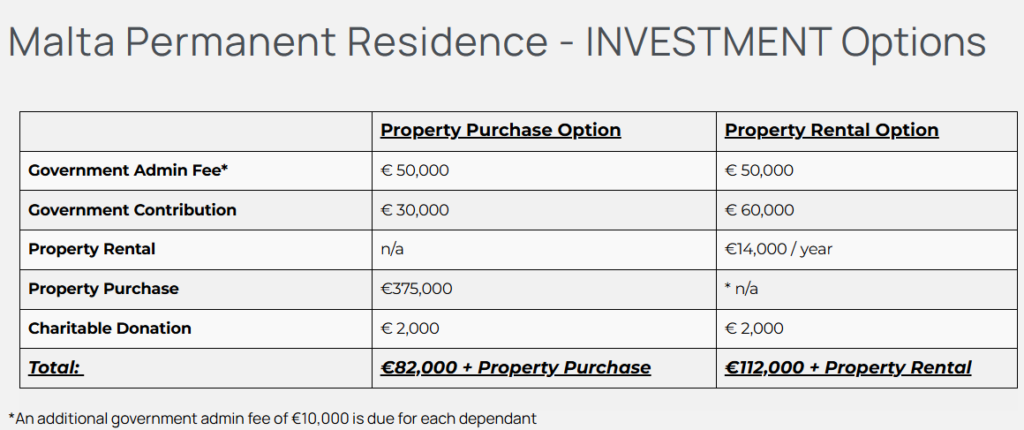
The investor under the MPRP must make three different types of contributions and investment. These are split in: contribution & administrative fees paid to the government of Malta, a donation to charity and an investment into real estate.
Real Estate Investment
The main applicant must purchase or rent a property in Malta, which is to be kept for at least 5 years.
- Minimum Purchase Price: €375,000 for properties in Malta or Gozo.
- Minimum Annual Rent: €14,000 annually for properties in Malta or Gozo
Donation to Charity
The main applicant must make a donation to charity of €2,000
Government Administration Fees and Contributions
The main applicant must pay Government Administration Fees & Contributions as follows:
Main Applicant:
- A non-refundable administration fee of €50,000 is required:
- €15,000 payable within 1 month of application submission,
- Remaining €35,000 due within 2 months of receiving the Letter of Approval in Principle.
- Additional Government Contribution:
- For applicants purchasing property: €30,000
- For applicants renting property: €60,000
This Government Contribution must be paid within 8 months of the Letter of Approval in Principle.
Each Family member
- A fee of €10,000 per dependant, comprising:
- €5,000 as a non-refundable administration fee, payable within 2 months of the Letter of Approval in Principle, and
- €5,000 contribution payable within 8 months of the Letter of Approval in Principle.
What are the benefits of the MPRP?
Many are the benefits of the Malta Permanent Residence Programme, with the key advantages being:
- MPRP holders are granted the right to travel in the Schengen Area without a visa. The visa-free stay in the European Schengen Area is for 90 days out of 180 days.
- MPRP holders receive the right to work and live in Malta indefinitely.
- MPRP holders are not required to live in Malta for a minimum time in order to keep their permanent residence status.
- MPRP status is valid for life.
How to apply for Permanent Residency in Malta?
Under the Malta Permanent Residence Programme Regulations (L.N. 310 of 2024), investors cannot apply for permanent residence independently. Instead, a licensed agent accredited by the Government of Malta ensures the investor complies with all programme requirements. The agent provides comprehensive support throughout the process, from document preparation to the issuance of the permanent residence card.
Dr Priscilla Mifsud Parker is a Licensed Agent under the Malta Permanent Residence Programme (MPRP) regulations with Licence AKM-ACCA.
The Malta Permanent Residence Programme (MPRP) continues to be a popular choice for third-country nationals seeking to reside in Malta.
Following the publication of Legal Notice 310 of 2024 on the 19th of November 2024, the Residency Malta Agency (RMA) has announced a number of significant amendments. These updates address changes to the Malta Permanent Residence Programme (MPRP) submissions starting from the 1st of January 2025.
Key Features of the current MPRP Regulations
- Eligibility Criteria: Applicants must possess capital assets of at least €500,000, with €150,000 in financial assets. They must also lease a property for a minimum of €10,000 per annum in the South of Malta or Gozo, or €12,000 per annum in the North of Malta. Alternatively, they can purchase a property valued at €300,000 in the South of Malta or Gozo, or €350,000 in the North of Malta
- Contribution Requirements: A non-refundable contribution of €68,000 is required when purchasing a property, or €98,000 when renting. Additionally, applicants must donate €2,000 to a Malta-registered NGO or charity organisation as approved by the agency.
- Health Insurance: All applicants and their dependants must have a health insurance plan covering all risks in Malta
- Dependants: The programme allows for the inclusion of the main applicant’s spouse, unmarried and financially dependent children without any age limitations, and parents or grandparents who are wholly maintained by the main applicant
Malta Permanent Residence Programme Proposed Changes for 2025
- Revised Eligibility Criteria: From January 1, 2025, applicants have two options to show that they are economically self sufficient.
Option 1: The main applicant must present evidence of assets valued at not less than €500,000, with a minimum of €150,000 in financial assets, or
Option 2: The main applicant must present evidence of assets valued at not less than €650,000, with a minimum of €75,000 in financial assets
- Dependants’ Age Limit: A child of the main applicant or their spouse is eligible as a dependant as long as they have not yet reached the age of 29, are unmarried, and still financially dependent on the main applicant
- Qualifying Property: The minimum value for qualifying owned property will be €375,000, and the minimum annual rent for qualifying rented property will be of €14,000. This therefore removes the difference between investing in Malta or in Gozo/South of Malta.
- Administration Fees and Contributions:
-
- A non-refundable administration fee of €50,000 is to be paid for the main applicant, with €15,000 payable within one month of application submission and the remaining €35,000 within two months of receiving a Letter of Approval in Principle.
-
- Dependants’ fees include a €10,000 fee for each dependant, with €5,000 as a non-refundable administration fee payable within two months of receiving a Letter of Approval in Principle, and the remaining €5,000 contribution payable within eight months.
-
- A contribution of €30,000 will apply for the main applicant if opting for a qualifying owned property, or €60,000 if renting a property. This shall be payable within eight months of receiving a Letter of Approval in Principle.
Applications Submitted Prior to 2025
Applications submitted under the regulations prior to the publication of Legal Notice No 310 of 2024 will be accepted until December 31, 2024. These applications must include the minimum required documentation, such as Form MPRP 1, Form MPRP 10 for the main applicant and each dependant, Power of Attorney, certified true copies of passports, and a declaration signed by the main applicant
All remaining documentation must be submitted by the 28th of March 2025, or the application will be considered withdrawn.
The MPRP is designed to attract high-net-worth individuals and their families, offering them the opportunity to enjoy the benefits of residing in Malta, including a favorable tax regime and a high quality of life.
Our Malta Permanent Residence Services
At ACC, a licensed Maltese Immigration Firm (Licence No. AKM-ACCA), we specialize in guiding high-net-worth international families and businesses across a range of areas, including residency and citizenship, corporate law, taxation, financial services, fintech, and property. For over 20 years, our dedicated Malta Permanent Residence specialists have successfully assisted hundreds of individuals and families, from expatriate retirees to emigrants seeking new career opportunities. We proudly promote Malta as a prime destination for investment and relocation, reflecting the country’s rich tradition of hospitality and multiculturalism.
Our team provides expert advice on the legal and tax implications of the residence application process, offering tailored guidance to ensure compliance and efficient timelines based on your unique circumstances. We cover the requirements of various residence schemes in Malta and offer practical support for relocation needs, including transportation, insurance, schooling, and healthcare coverage. Let us help make your transition to Malta seamless and rewarding

Applying for Maltese citizenship or residence, and relocating to Malta is an exciting venture, offering a blend of Mediterranean charm and weather with sunny summers and mild winters. Malta also boasts a rich historical and cultural heritage with numerous UNESCO World Heritage Sites, including the ancient Megalithic Temples and the historic city of Valletta. The fusion of different cultural influences, from the Phoenicians to the British, creates a unique and fascinating environment. Malta offers a high quality of life with a strong sense of community, low crime rates, and excellent healthcare and educational services.
As you prepare to make this beautiful island your home, choosing the right property is a crucial step. Here’s a guide to help you navigate the property market in Malta and find the perfect place to call home.
Understanding the Maltese Property Market
The Maltese property market is diverse, catering to various tastes and budgets. From historic townhouses in Valletta to modern apartments in Sliema and luxury villas in St. Julian’s, there’s something for everyone. Understanding the local market trends, property types, and legal considerations is essential for making an informed decision.
Should I buy or rent?
Deciding whether to buy or rent property in Malta depends on your personal circumstances, financial situation, residency or citizenship by investment programme minimum spend requirements and long-term plans.
Buying property can be a solid investment due to Malta’s stable real estate market and very good potential for property value appreciation. It offers the benefits of owning something you can call your own, the right to make any amendments to the property and the right to rent it out. On the latter point, one needs to consider whether the investment migration programme under which the property is bought allows the rental of the qualifying property.
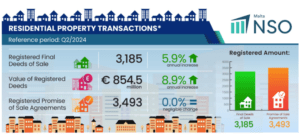
In a recent publication by the Maltese National Statistics Office (NSO) issued in June 2024, there is a clear indication that Residential Property Transactions were on the increase. A snippet of the results can be found below:
Renting, on the other hand, provides more flexibility, lower initial costs, and less responsibility for property upkeep. It is ideal for those who may be staying short-term or wish to get to know the island better before they commit to purchase. Ultimately, the decision should align with your financial readiness, lifestyle preferences, and future goals.
Location is key
Your choice of location will significantly impact your lifestyle in Malta. Here are some popular areas to consider:
- Valletta: The capital city, known for its historical significance and vibrant cultural scene. Ideal for those who appreciate history and urban living.
- Sliema and St. Julian’s: These bustling coastal towns offer a mix of shopping, dining, and nightlife. Perfect for expats and young professionals seeking a lively environment.
- Gozo: Malta’s sister island, known for its tranquil and laid-back lifestyle. Great for those looking for a quieter, more rural setting.
- Mellieha and St. Paul’s Bay: These northern towns provide beautiful beaches and a more relaxed pace of life, suitable for families and retirees.
- Lija, Attard and Balzan: Often referred to as ‘The Three Villages’ situated in central Malta. Fitting for individuals who need to travel around the island frequently and with ease.
Property Types
Malta offers a range of property types to suit different preferences:
- Apartments: Available in various sizes, from studios to spacious penthouses. Apartments are popular in urban areas and often come with present-day amenities.
- Houses of Character: These are highly sought after for their unique charm and historical significance, providing a living experience that is deeply connected to Malta’s cultural heritage.
- Townhouses: These properties offer a combination of traditional Maltese architecture and contemporary comforts. They are generally newer than houses of character, often from the late 19th to early 20th centuries, with a more uniform architectural style.
- Villas: Often found in more suburban or rural areas, villas provide luxury, privacy, and ample space, perfect for families or those seeking a more secluded residence.
- Farmhouses: Particularly in Gozo and rural Malta, farmhouses offer rustic charm and expansive grounds, appealing to those desiring a connection to nature.
Budget Considerations
The cost of property in Malta can vary widely depending on the location and property type. Urban areas like Sliema and St. Julian’s are generally more expensive than rural or less central areas. Establish a clear budget and consider additional costs such as property taxes and notary fees if you are purchasing, maintenance, and utilities.
Most houses would already have electricity and water supplies. For newly built properties, one would need to apply for these utilities through Arms Ltd.
One other consideration is the minimum property thresholds established by the chosen residence programme. We hereby outline the property requirements for Non-EU nationals seeking Permanent Residence in Malta:
- Rent a property for:
- €10K per year if the property is in Gozo or South of Malta
- €12K per year if the property is in Central or North of Malta
OR
- Purchase a property for:
- €300,000 if the property is in Gozo or South of Malta
- €350,000 if the property is in Central or North of Malta
On the other hand, if opting to apply for citizenship by investment in Malta, the minimum value to purchase a property is of €700,000, and when renting a property, it is of €16,000 annually.
Legal and Administrative Steps
Whether you decide to go for property rental or purchase, it is always prudent to appoint a property lawyer to oversee the property transaction and guide you accordingly.
Purchasing property in Malta involves several legal and administrative steps:
- Due Diligence: Conduct thorough checks on the property’s title and any potential encumbrances. This task is usually carried out by a notary who is usually appointed by the purchaser.
- Purchase Agreement: Once you find a property, a preliminary agreement (Konvenju) is signed, outlining the terms and conditions of the sale.
- Permits and Taxes: Non-EU citizens may require an Acquisition of Immovable Property (AIP) permit. Be aware of taxes such as stamp duty and property registration fees.
Lifestyle Considerations
When choosing your property, think about your lifestyle needs:
- Proximity to Amenities: Consider the property’s proximity to schools, healthcare facilities, supermarkets, and recreational areas.
- Transport Links: Ensure good connectivity to public transport or main roads if you plan to commute.
- Locality Atmosphere: Research the neighborhood’s community vibe and ambiance to ensure it aligns with your preferences.
Final Thoughts
Choosing the right property when setting up residence in Malta involves careful consideration of location, property type, budget, and residence programme requirement. By understanding the local market and aligning your choice with your lifestyle needs, you can find a property that not only meets your practical requirements but also enhances your living experience on this stunning Mediterranean island. Whether you seek the hustle and bustle of urban life or the serenity of a rural retreat, Malta offers a wealth of options to create your perfect home.
Relocating to a new country with children is a significant life change that involves careful planning and consideration. Malta, an island in the Mediterranean, offers a unique blend of historical richness, vibrant culture, a safe location and a welcoming environment, making it an attractive destination for families. However, relocating to Malta with minors requires attention to several important aspects to ensure a straightforward move.
This article covers the essential considerations for your family!
Legal Requirements and Documentation
Residence Permits
Before relocating, it is crucial to understand the available residence permit options. Citizens of the European Union (EU) and the European Economic Area (EEA) do not need a visa to enter Malta but must apply for a residence permit if they plan to stay longer than three months.
Non-EU citizens, depending on their country of origin, may need a visa to enter Malta and must also apply for a residence permit. The most sought-after option for Non-EU nationals is the Malta Permanent Residence Programme (MPRP) which includes all the family members in one application. It is advisable to contact a local Licensed Agent such as ACC Advisors to assist with your application.
Documentation for Minors
It is important to ensure that minors have a valid passport. Depending on the country of origin, additional documents such as birth certificates and custody papers (if applicable) may be required. All documentation submitted for residence application in Malta need to be translated into English.
Education
School Enrolment
Malta boasts a robust educational system with public, church, private, and international schools. Public schools follow the Maltese curriculum and instruction is primarily in English and Maltese. Private and international schools offer various curricula and most lessons are conducted in English.
Below one can find a list of private schools and universities in Malta:
Schools
- Chiswick House School – https://www.chs.edu.mt/
- QSI International School of Malta – https://malta.qsi.org/
- San Andrea School – https://www.sanandrea.edu.mt/
- San Anton School – https://www.sananton.edu.mt/
- Saint Edwards College – https://stedwards.edu.mt/
- Verdala International School – https://www.verdala.org/
Universities
- University of Malta – https://www.um.edu.mt/
- American University of Malta – https://aum.edu.mt/
- Barts and the London School of Medicine – https://www.qmul.ac.uk/malta/
Language Considerations
English and Maltese are both official languages of Malta. While English is widely spoken, learning basic Maltese phrases can enrich your family’s experience and help your children integrate better into the local culture and school environment.
If the applicants moving to Malta wish to integrate even more, they can enrol in a Maltese for foreigners course. In addition, international schools often have language support programmes to help non-native English speakers.
Healthcare
Health Insurance
EU/EEA citizens can access public healthcare services in Malta with their European Health Insurance Card (EHIC). Non-EU nationals must have a private health insurance policy unless they work in Malta and contribute to Malta’s national insurance and social security.
Vaccinations
Ensure your child’s vaccinations are up to date according to your home country’s schedule. Malta has a comprehensive vaccination programme, and you may need to show proof of vaccinations for school enrolment.
Housing
Finding a Suitable Home
When looking for a property to buy or rent, consider factors such as the minimum qualifying value depending on the immigration programme chosen, proximity to schools and recreational areas for example playgrounds, kids focused activity centres like Esplora and restaurants with play areas for the kids.
Popular residential areas for expatriate families include Sliema and St. Julians while other families prefer quieter, more central areas like Balzan, Lija, Naxxar and Attard.
Financial Considerations
Cost of Living
The cost of living in Malta is generally comparable to that of other European countries. Everyday expenses, including groceries and dining out are reasonable. Public transport is provided for free for all Maltese residents.
Health insurance costs are relatively affordable especially for minors, while tuition fees for private and international schools can be expensive. Housing costs can vary depending on the location and type of accommodation chosen.
Support Networks
Expat Communities
Malta has a vibrant expatriate community. Joining expat groups, can provide valuable support and advice, helping your family settle in more quickly.
Local Support Services
There are various local organizations and services designed to help families, including family support groups, and child welfare services.
It is always advisable to prepare minors psychologically before the transition to another country actually takes place. If kids are still overwhelmed by the emotional journey associated with the relocation itself, there are many support services offered by various professionals in Malta that help ease the minor’s worries.
Plan of Action
Relocating to Malta with children involves thorough preparation, from securing the necessary residence permits to selecting the right school and integrating into the local community. Malta’s blend of Mediterranean charm, historical depth, and modern amenities makes it a fantastic place for families. By addressing the key areas outlined in this guide, you will be on the right track for a successful shift towards your new life in Malta.
Contact one of our Professional Advisors if you wish to learn more about relocating to Malta. ACC is a licensed agent in Malta and can assist with your relocation. (AKM-ACCA)
Amendments have been implemented to the legislation earlier this month by L.N.57 of 2024, amending the Malta Permanent Residence Programme Regulations (MPRP) and L.N. 56 of 2024, amending the Malta Residence and Visa Programme Regulations (MRVP).
The objective of these amendments is to clarify a number of matters for the better implementation of both programmes. The main amendments from these two legal notices are:
Malta Permanent Residence Programme (MPRP)
- Additional dependants can be exempted from the provision of a health insurance if they do not apply for a residence card;
- Residency Malta has the right to stop the benefits of a certificate while conducting an investigation;
- The Agency can exchange information with other authorities empowered to request information.
Malta Residence and Visa Programme (MRVP)
- Residency Malta can withdraw/withhold residency cards if the dependants are not in possession of a health insurance policy;
- The Agency has the discretion to extend any time limit, upon good cause being shown, for applications concluded after the cut-off day.
The Malta Residence and Visa Programme (MRVP) was replaced by the Malta Permanent Residence Programme (MPRP) in March 2021, however, the Agency has maintained its monitoring and compliance function, by conducting checks on beneficiaries, according to law. Moreover, beneficiaries are still able to benefit from the programme if they need to add more dependants after the issuance of a Residency Certificate.
The Malta Permanent Residence Programme (MPRP) is a residency-by-investment programme based on investments in property and government contributions, designed to attract non-EU nationals who wish to obtain permanent residency in Malta.
Benefits:
- the right to settle, stay and reside permanently in Malta;
- enjoy Visa-free travel across Schengen;
- penetrate Malta’s affordable real estate market;
- may include up to four generations in an application.
Eligibility and Requirements:
- be third country nationals, non-EU, non-EEA and non-Swiss;
- not hail from sanctioned countries, as announced from time to time by the Agency;
- not benefit under other pertinent regulations and schemes;
- be in receipt of stable and regular financial resources, sufficient to maintain themselves and their dependants, without recourse to the social assistance system of Malta;
- show they have capital assets of not less than €500,000, out of which a minimum of €150,000 must be financial assets. Applicants may also provide a capital of €650,000, with €75,000 of that amount required to be in the form of financial assets.;
- be fit-and-proper individuals and have a clean criminal record;
- not pose any potential threat to the national security, public policy, public health or public interest.
Nestled in the heart of the Mediterranean with wonderful sandy and rocky beaches, a pro-business perspective, high academic standards, premium health services and a Mediterranean climate are some of the factors that make Malta a welcoming nation. This archipelago of islands consisting of Malta, Gozo and Comino offers an enticing environment for investing seeking a strategic location in Europe. English is also an official language of Malta making it easier for foreigners to relocate or get accustomed with the island and its residents.
By means of the Granting of Citizenship for Exceptional Services Regulations, Maltese law allows for the granting of citizenship by a certificate of naturalisation to foreign investors and their families who contribute to the economic development of Malta by making a contribution to a state fund, donate to charity and rent or buy a property on the island.
Why is the Maltese Citizenship by Direct Investment Programme (MCES) so significant in today’s world where everyone is seeking peace of mind for their families? Hereunder, we explore the benefits of this exciting journey:
Investment is only required after approval
A significant advantage of the Maltese Citizenship by investment regulations is that the investment is made only after the application has been approved. This gives additional reassurance to the applicants who would first receive their approval and then proceed with the investment.
One application for all the family
An application for citizenship can include up to four generations in one application. This includes the main applicant, spouse, dependent unmarried children under the age of twenty-nine and also dependent parents and grandparents over the age of fifty-five of both the main applicant and the spouse.
Right to reside and settle permanently in Malta
Obtaining Maltese citizenship will give its holder and family members the right to reside permanently in Malta and in any European country. Malta provides an exceptional quality of life, which makes it an attractive destination for those seeking a balanced lifestyle. The island’s accessibility, diverse recreational opportunities, and high standard of living contribute to a thriving community that complements the business landscape.
Dual Citizenship is allowed
Malta allows dual and multiple citizenship, and this means that applicants who obtain Maltese Citizenship by Direct Investment do not need to give up their previous nationality. This is particularly advantageous for those who want to preserve their ties to their home country while gaining access to the advantages that come with Maltese citizenship.
Citizenship granted to future generations
One notable advantage of Maltese citizenship is its intergenerational accessibility, allowing the enjoyment of citizenship to extend seamlessly to future generations. This unique feature ensures that descendants can inherit the rights and privileges associated with Maltese citizenship, creating a lasting and meaningful legacy, irrespective of the place of birth.
Citizenship in a safe environment
Malta is regarded as one of the safest countries in Europe and this has captivated the interest of many families looking for a secure and stable jurisdiction. Malta has also earned a solid reputation among world travelers and migrants especially since crime rates in Malta have always been low compared to other destinations.
A country with economic and political stability
Malta’s economy has experienced a robust economic growth with a remarkable post-pandemic recovery. The country’s economy showed strong advancement and has been historically attracting significant foreign direct investment.
Reliable Healthcare
On becoming citizens of Malta, applicants have free access to all state health centres, community clinics and the Malta government hospital. All medical services are provided free of charge and delivered by a multi-professional team including doctors, physiotherapists, podiatrists, radiographers, speech and language pathologists, phlebotomists, social workers, dieticians, and nutritionists.
In addition, Maltese citizens also get access to the European Health Insurance Card which grants them emergency access to medical treatment in the EU.
Educational Advantages
Beneficiaries of Maltese citizenship will also have access to a high-quality education system which is free of charge. Additionally, one can also benefit from the ability to study in other EU countries under favourable conditions.
Right to live, work and study in Europe
Once the applicants become Maltese/EU nationals, they have the right to live and move within the EU and they would not require a permit to work in any EU country. They can also relocate to study in any member state of their choice.
Visa-free travel to over 190 destinations
In the 2024 passport index, the Maltese Passport has ranked fifth place globally. This ranking is based on the number of countries that an individual can access without a visa or with a visa on arrival with a certain passport. A Maltese passport holder benefits from visa free travel to 190 travel destinations including Australia, the European Union, USA and Canada amongst other countries. This facilitates hassle-free international travel, making it convenient for business, leisure, or other purposes.
Doing Business in Malta and Europe
Maltese nationals can set up, operate, and develop a business in Malta and in any country of the European Union and therefore benefit from various business expansion opportunities.
Property Investments
Investing in the Maltese real estate market has always been highly regarded since the land available on the island is limited and therefore it yields high returns both from rental and from property resale. On obtaining Maltese citizenship, individuals are free to purchase properties in all locations in Malta and no longer require an AIP permit.
In summary, obtaining Maltese citizenship provides a multitude of benefits, ranging from travel privileges and business opportunities to the ability to enjoy a high quality of life within the European Union. The flexibility of dual citizenship further enhances the appeal of Malta as a desirable destination for individuals seeking a well-rounded and globally connected lifestyle.
Challenges in applying for Maltese Citizenship
The Maltese Citizenship by Direct Investment programme requires the applicants to be residents of Malta for a period of 12 or 36 months and therefore it takes time to acquire a Maltese passport since there is a lengthy waiting period, mainly because of the four-tier due diligence exercise done by the authorities. Notwithstanding this, applicant still benefit from receiving a Maltese residence card within two weeks of submission of the application.
Another challenge is that the direct investment which is done to the Maltese Government Fund is non-refundable. This however is only to be paid once an application has been approved. Additionally, the qualifying property bought or rented to fulfil the programme requirements, cannot be rented out to third parties during the first five years holding period.
The Maltese Citizenship application process comprises of a very strict due diligence exercise on all the family members included in the application. Furthermore, applicants need to submit detailed information on how they generated their funds over the years. This assembling of documentation can be seen as cumbersome although at the same time it proves that Malta gives value to the integrity of the applicants to whom citizenship is being granted.
How to obtain Malta Citizenship by Investment
In order to be granted Maltese Citizenship by Direct Investment under the Granting of Citizenship for Exceptional Services Regulations, applicants are first required to visit Malta and apply for a residence card. Once the residence cards are issued in a period of around four weeks, applicants can then submit a citizenship eligibility application. Following a thorough due diligence exercise, and once the application has been approved the applicant is required to:
- Pay a government contribution of:
- €750,000 if applying for citizenship after 1 year of residence
OR
- €600,000 if applying for citizenship after 3 years of residence
Pay an additional €50,000 contribution for each dependant that the main applicant adds to the application. This can include the spouse, children up to the age of 28 and parents and grandparents of the applicant and of the spouse.
- Make a charity donation of €10,000 to a local NGO
- Rent or Purchase Property in Malta, which is to be kept for at least five years:
- Option 1 – Property Rental – The applicant should rent a property for a minimum value of €16,000 per year.
OR
- Option 2 – Property Purchase – The applicant should purchase a property for a minimum value of €700,000.
A Malta Citizenship by Investment application can only be submitted at Community Malta Agency via a Licensed Agent.
ACC Immigration (Malta company registration number C-44042) is duly authorised to act as a licensed Malta agent and holds licence number AKM-ACCA.
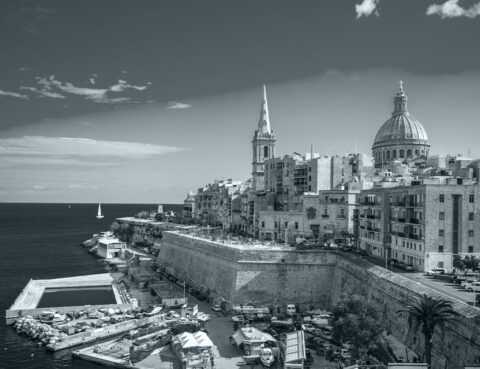
Malta is recognised as a jurisdiction welcoming high net worth families wishing to embrace the opportunity of becoming Maltese citizens. The country acts as a bridge between the African and European continents therefore attracting ongoing foreign investor interest. This is also because Malta has one of Europe’s fastest growing economies which is continuously adapting to global dynamics.
The Granting of Citizenship for Exceptional Services Regulations allow for the granting of Maltese citizenship to individuals and their families contributing to the economic development of the country. Each application submitted under these regulations undergoes a strict four-tier due diligence process.
Once a family is awarded Maltese citizenship, the applicants can benefit from various opportunities in Malta and abroad.
Legal Notice 437 of 2020 specifies the requisites for the Granting of Maltese Citizenship for Exceptional Services Regulations.
To be eligible for Maltese citizenship under the exceptional investment route, the applicant must satisfy a number of financial requirements:
Government Residence Permit Fees
The first step to apply for citizenship by investment under these regulations is to visit Malta and apply for Maltese residency. At this stage, the prospective applicant signs a power of attorney granting the authority for the licenced agent to act on his behalf for the duration of the application process. The licenced agent will perform the first-tier level of due diligence and submits the residence application.
During the residence application, applicants are required to settle the government residence permit fees which amount to €5,027.50 for the main applicant and €1,027.50 for each dependent. During this application the main applicant is also required to pay a non-refundable fee of €10,000 as a part payment of the main contribution.
| Main Applicant | Part Payment of Contribution | €10,000 |
| Main Applicant | Residence Permit + Card | €5,027.50 |
| Each Dependant | Residence Permit + Card | €1,027.50 |
Residency status is issued for 36 months which can only be extended if an eligibility for citizenship application has been submitted.
Government Administrative & Due Diligence Fees
Following the submission of the residence application, residence cards are issued within a few weeks.
Subsequently the citizenship eligibility application can be submitted. At this stage, one submits documents relating to the source of wealth and funds, birth and marriage certificates and police conduct certificates. The Community Malta Agency performs Tier 2 due diligence at this stage and ensures the completeness of the application. Once this is done and the application is deemed to contain all the necessary information, the third and fourth tier due diligence is done, and the findings of this exercise is presented to the Minister responsible for citizenship.
The due diligence process starts with what is known as the M1 phase, at which stage the application is checked for completion, to ensure that all the administrative forms have been provided and are adequately completed, with all the supporting documents. This part of the process categorises an application as an M1-A, in which case it can proceed to the next stage unencumbered, or an M1-B which implies that some elements of the application are missing.
If an application is deemed an M1-B, a report is issued containing the amendments or the information required. This report may request amendments to a government form, missing documentation incorrect authentication of documents.
When an application clears the M1 stage, it proceeds to what is known as the M3 stage where a detailed, critical review of the application and the supporting documentation is done.
Fees to be paid at this stage are the following:
| Applicant | Due Diligence Fee | €15,000 |
| Each Dependant (12 years of age and over) | Due Diligence Fee | €10,000 |
| Benefactor | Due Diligence Fee | €15,000 |
Government Contribution
After the due diligence process has been completed and the Letter of Approval has been issued, the applicant would be required to satisfy the three main investment components of the Malta Citizenship by Investment Regulations. This is done following the 12 or 36 months from the date of issue of the residence cards.
The first requirement is to pay a non-refundable government contribution amounting to €600,000 if the applicant wishes to pursue the 3 year route to citizenship or amounting to €750,000 if the applicant decides to follow the 1 year route.
There is an additional government contribution of €50,000 to be paid for each dependent added to the same application. This is paid on receipt of Letter of in Principle Approval.
Donation to a Voluntary Organisation
The applicant needs to donate €10,000 to a local registered cultural, sport, philanthropic, scientific, animal welfare or artistic non-government organisation or society registered with the Commissioner for Voluntary Organisations.
Property Investment
Upon receipt of the Letter of in Principle Approval, a Malta citizenship applicant needs to choose a qualifying property to purchase or rent. The chosen qualifying property is to be kept for five years. The property requirements are outlined below:
Option 1 – Property Rental
The applicant needs to spend a minimum of €16,000 rental per year.
OR
Option 2 – Property Purchase
The applicant needs to spend a minimum of €700,000 when purchasing the property.
| Applicant | Government Contribution | €600,000 / €750,000 |
| Each Dependent | Government Contribution | €50,000 |
| Applicant | Charity Contribution | €10,000 |
| Applicant | Real Estate Investment | €16,000 Annual Rent or
€700,000 Purchase of Property |
Furthermore, applicants must also provide documentary evidence that any personal, commercial or financial ties to the country that they opted to commit to do, in their residency proposal letter have been completed.
Once the applicant fulfils the exceptional investment, the donation and property requirements, he is invited to come to Malta to take the Oath of Allegiance and the Maltese Certificate of Naturalisation is issued.
A Malta Citizenship by Investment application can only be submitted at Community Malta Agency via a Licensed Agent.
ACC Immigration Advisors (Malta company registration number C-44042) is duly authorised to act as a licensed Malta agent and holds licence number AKM-ACCA.
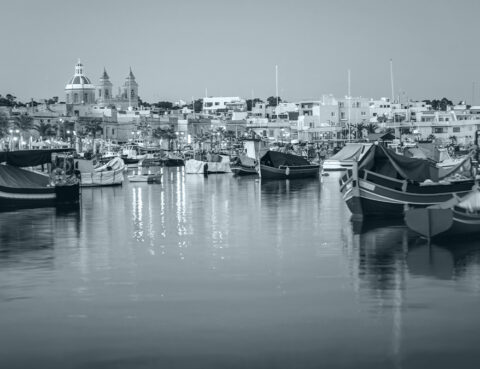
UPDATE: Following the publication of Legal Notice 310 of 2024 on the 19th of November 2024 and Legal Notice 146 of 2025, the Residency Malta Agency (RMA) has announced a number of amendments to the Malta Permanent Residence Programme.
Read more on the 2025 amendments of the MPRP, the new requirements and investment options.
Malta Permanent Residence Programme 2024
There are several reasons why Malta has always been considered as one of the best places to have a second residency. Malta is a democratic country and a European Union member state with a history of political and economic stability. The island’s low crime rate, the unique archaeological sites, the attractive mediterranean climate, the highly regarded education system, the top-quality healthcare services and other distinctive attributes have helped high-net-worth families choose Malta as their place of residence for their family’s relocation.
This interest has increased further with the introduction of the Malta Permanent Residence Programme (MPRP). Why is it so?
Residency for life, for all the family
The validity of a residence permit issued via the MPRP is for life. This Permanent Residence status is retained by children who are currently financially dependant on their parents but might have their own family or employment in the future. In addition, the spouse and future kids of the currently dependant children may also obtain their Maltese Permanent Residence status. This is unlike any other residence by investment programmes where there are age restrictions to include children in the same application.
All the family can apply together in one application (no age limits)
An MPRP application can include the Main Applicant, the spouse, dependant children (without age limitations) and also dependant parents and grandparents. This therefore makes it possible to include up to four generations in one application.
Investment is only required after approval
A major advantage of the Maltese Permanent Residence Programme is that the investment is to be carried out only after the application has been approved. This gives additional security to the applicants who would have received their approval prior to investing. Other residence by investment programmes in Europe require the applicant to make an investment prior to submitting an application.
Permanent Residence is effective on approval
In Malta, the Permanent Residence status is instantly acquired on the approval of an application and therefore applicants do not need to wait for a specific number of years or sit for any language tests in order to obtain permanent residence status.
Visa Free Travel in the Schengen Area
Maltese Permanent Residence permit holders are granted permission to travel to all the Schengen countries for 90 out of 180 days.
No minimum physical stay in Malta
The Maltese Permanent Residence Programme does not impose any annual physical stay in Malta that the applicants need to fulfil while the application is being processed or after being granted approval.
Right to reside and settle permanently in Malta
Many families look for good quality of life, education for their children, access to business opportunities and most of all a stable and safe jurisdiction. This is why numerous families also relocate to Malta after obtaining their Permanent Residence status and immerse themselves in a safe mediterranean lifestyle that the island offers.
MPRP – Financial Requirements
To be eligible for the MPRP, applicants must:
- Pay a non-refundable government administrative fee of €40,000
- Pay a government contribution of €28,000 if purchasing a property or €58,000 if renting a property
- Pay an additional €7,500 government contribution for each parent or grandparent added to the application
- Make a charity donation of €2,000 to a local NGO or charity organisation.
- Rent or Purchase Property (The chosen property is to be kept for 5 years):
- Property Rental
- Located in Central or North Malta – minimum spend of €12,000 per year
- Located in South of Malta or Gozo – minimum spend of €10,000 per year
- Property Rental
OR
- Property Purchase
- Located in Central or North Malta – minimum spend of €350,000
- Located in South of Malta or Gozo – minimum spend of €300,000
- Applicants must show that they are in possession of at least €500,000 in assets, out of which €150,000 should be liquid assets.
A Malta Permanent Residence application can be submitted at Residence Malta Agency via a Licensed Agent.
ACC Immigration Advisors (Malta company registration number C-44042) is duly authorised to act as a licensed Malta agent and holds licence number AKM-ACCA.
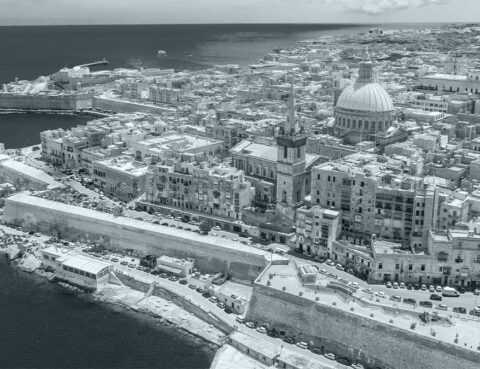
The Maltese Passport has ranked fifth place in the 2024 passport index complied recently using data deriving from the International Air Transport Authority (IATA). This is a steady increase for Malta’s passport which previously ranked at eighth place in the same passport index. Switzerland also shares the same fifth passport rank with Malta. This index ranks France, Germany, Italy, Japan, Singapore and Spain in the first place while Finland, South Korea, Sweden are in the second rank in terms of their passport’s global mobility. On the other hand, the lowest ranked passports are those of Afghanistan, Syria, Iraq and Pakistan.
The ranking is based on the travel destinations the passports gives its holder access to without a visa or with a visa on arrival.
A Maltese passport holder is allowed visa free travel to 190 jurisdictions including the European Union, Australia, USA and Canada amongst other countries. Moreover, a Maltese passport allows its holder the right to settle, study, work, invest and retire in all the 27 European Union countries.
Obtaining Maltese Citizenship
Individuals who wish to benefit from better travel opportunities can apply for Maltese Citizenship either through descent, marriage or else investment under the Granting of Citizenship for Exceptional Services Regulations by submitting an application at Agenzija Komunita Malta via a Licensed Agent. This is subject to satisfying the programme requirements which include evidence of legal residency in Malta for twelve or thirty six months, making a contribution to the National Development and Social Fund, purchase or rent a residential property in Malta or Gozo and a making a philanthropic donation of €10,000.
Benefits of applying for Maltese Citizenship
The benefits of applying for Maltese citizenship also include:
• Access to a robust and transparent European financial centre
• A safe Mediterranean place to live in which also grants free educational and healthcare access
• The ability to include one’s spouse, children, parents and grandparents in the same application
ACC Immigration Advisors (Malta company registration number C-44042) is duly authorised to act as a licensed Malta citizenship agent and holds licence number AKM-ACCA.